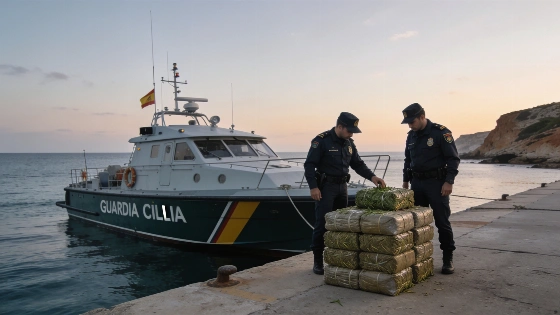
Guardia Civil detained ten suspects after a narcolancha crew fired on officers off Huelva. Nearly six tonnes of hashish were seized. The operation highlights rising violence in Spain’s fight against drug trafficking.
Ten members of a criminal group have been arrested following a violent confrontation with the Guardia Civil off the coast of Huelva. The suspects, operating a narcolancha, opened fire on a patrol boat during a maritime chase, forcing officers to respond with their own weapons. The incident, which unfolded between Monday night and Tuesday morning, left one trafficker wounded and underscored the escalating risks faced by Spanish law enforcement in the region.
The pursuit began when customs surveillance teams identified a semi-rigid boat suspected of transporting drugs. As officers closed in, the traffickers attempted to evade capture with dangerous maneuvers, even throwing bales of hashish into the sea to obstruct the patrol. The situation escalated when the suspects fired at the agents, prompting a brief exchange of gunfire. Despite injuring one of the traffickers, the patrol boat suffered a mechanical failure and was forced to abandon the chase. The wounded suspect was later found on a Cádiz beach and taken to hospital.
By the following morning, the Guardia Civil had launched a coordinated operation to track down the narcolancha and its crew. On Thursday, officers intercepted the vessel and a second support boat in open waters, arresting nine suspects and seizing nearly six tonnes of hashish. The tenth suspect, previously injured and left behind by his accomplices, was also detained. Authorities have confirmed that the investigation remains active as they work to clarify each individual's role in the attack and the broader criminal network.
Recent data from the Centro de Inteligencia contra el Terrorismo y el Crimen Organizado (CITCO) points to a sharp increase in drug seizures in Huelva, with hashish confiscations doubling to 43 tonnes in 2025. The region has also seen a rise in violent incidents targeting law enforcement. Just three months ago, two Guardia Civil officers died in a collision during a similar pursuit, and in June, another group of traffickers fired assault weapons at agents during a failed hashish landing in Punta Umbría. The Asociación Unificada de Guardias Civiles (AUGC) has repeatedly warned of the 'extreme violence' now common in these operations, as traffickers gain access to increasingly powerful firearms.
While most armed confrontations are linked to disputes between rival groups or attempts to prevent drug thefts—known as 'vuelcos'—attacks on police are becoming more frequent. The trend is not limited to Huelva: across Andalusia, criminal organizations regularly clash with authorities. In May, a customs patrol boat was rammed by a semi-rigid vessel off Almería, and in November 2025, a National Police investigator was seriously wounded by gunfire during an anti-drug operation in Isla Mayor, Seville. One of the most serious recent incidents occurred in Cádiz, where two Guardia Civil officers were killed and four injured after a narcolancha rammed their zodiac in Barbate. The suspects in that case are set to face a jury trial.
This pattern of violence and high-risk chases is part of a broader trend affecting Spain’s southern coast. As noted in a related report, Spanish police have also dismantled human trafficking rings exploiting similar maritime routes, exposing both migrants and officers to significant danger. For example, authorities recently cracked down on groups smuggling migrants from Ceuta to Andalusia, highlighting the persistent challenges in securing Spain’s maritime borders.
Spain’s ongoing struggle with organized crime in the Strait of Gibraltar and surrounding waters continues to test the resources and resilience of law enforcement. The latest arrests in Huelva reflect both the scale of the trafficking problem and the growing willingness of criminal groups to use violence against police. With investigations ongoing, authorities remain focused on dismantling these networks and improving officer safety in one of Europe’s most active drug trafficking corridors.