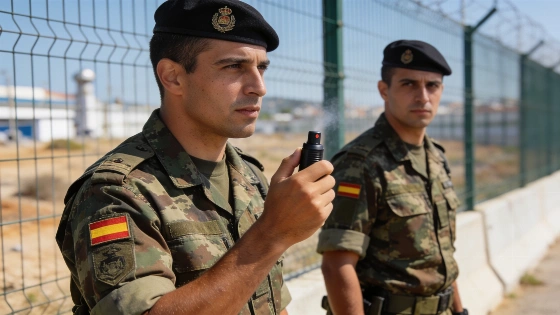
After weeks of patrols with only one loaded firearm per four soldiers, Spain’s Defence Ministry has started issuing pepper spray to military personnel in Ceuta. The move follows mounting criticism over troop safety and the lack of clear legal protection for those using non-lethal force.
For weeks, Spanish soldiers in Ceuta walked patrols with barely enough weapons to go around. Most squads had just one loaded firearm for every four or five troops. Many felt exposed. The risk was real. Spanish media, citing Defence Ministry instructions, reported that this shortage led to repeated incidents where only one soldier in a group was armed.
Now, the Defence Ministry has started handing out pepper spray. The Asociación de Tropa y Marinería Española (ATME) pushed for better protection, but says this new measure misses the point. ATME spokesperson Marco Antonio Gómez calls it a swap of one problem for another. He says, "It does not solve the underlying problem." The group also points out that soldiers have not received clear training or legal protection for using the spray. The main issue—too few firearms—remains.
Official instructions specify the use of Fitodefensa A-50: a 30 ml canister with 5% oleoresin capsicum, effective up to 4 meters and capable of six one-second bursts.
Troops started getting the spray before written instructions arrived. This caused confusion. By Friday, some guidelines began to circulate, but ATME could not confirm that every soldier had them. The spray is not assigned to each person. Instead, it is shared among those on patrol or guard duty, passed around at shift changes. Infodefensa and Libertad Digital reported that this lack of clear documentation led to confusion and uneven understanding of the rules.
The official instructions, titled Instrucciones empleo spray Fitodefensa A-50, lay out the details. Each can holds 30 milliliters of pressurized spray with 5% oleoresin capsicum. It works up to four meters away and can deliver about six one-second bursts. The document warns of strong eye and skin irritation and possible breathing problems. First aid is simple: fresh air, water, and soap—no rubbing the eyes. The Defence Ministry says the spray is only for aggression, violent resistance, or to protect national property and key infrastructure. Several official sources confirm this follows the rules of necessary force and proportionality.
Soldiers can use the spray if attacked, if someone resists violently, or to defend national property and vital sites. The goal is to stop aggression and neutralize threats. The rules stress progressive force and proportionality. But there are gaps. The guidelines do not mention what to do if minors are involved. There is also no clear legal support for soldiers who use the spray on duty.
Spanish weapons regulations allow pepper spray for self-defense under special conditions, but it is not considered standard-issue equipment for military personnel during regular service. This legal ambiguity has prompted ATME to request clarification from the Defence Ministry regarding the official status of the spray and the legal protections available to soldiers in case of complaints or lawsuits.
Gómez points to the legal gray area. "What if the aggressor is a minor? Most are not children but 17-year-olds, sometimes acting in groups or armed with stones." Recent attacks on soldiers in Ceuta have led to injuries and evacuations. ATME says the current approach leaves too many questions. Without clear legal coverage, troops feel exposed. ABC and El Faro de Ceuta report that the Defence Ministry has not answered media questions about using pepper spray on migrants, including minors. This silence has fueled more debate.
The issue hit national headlines when PP deputy Ana Belén Vázquez waved a can of pepper spray in Congress. She said it showed the insecurity faced by women and teachers in Ceuta. Security expelled her from the chamber. After the canister was handled, a dozen people suffered eye and breathing irritation. Several bathrooms had to be closed. Gómez draws a sharp line: "I am told I cannot carry my weapon, but I am given a spray that just got a deputy expelled from Congress for being considered a weapon."
Some patrols have started arming all members with firearms, but this has not been officially announced. ATME says the old rule—one loaded weapon per four soldiers—put too much pressure on one person to make life-or-death calls for the group. "We are trained to know when and how to use weapons, not to act recklessly," Gómez says. The association wants soldiers recognized as law enforcement agents and military service classified as high-risk work.
The Defence Ministry faces a real test. The pepper spray rollout was meant as a quick fix. Instead, it has exposed deeper problems with how troops are equipped and protected at home. Until the government closes the legal and operational gaps, soldiers in Ceuta will keep feeling unsafe. The situation in Ceuta shows a Defence Ministry stuck between politics and real-world needs. Troops are left to deal with the fallout.