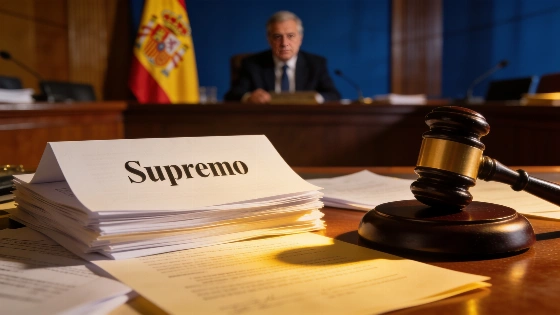
The Supreme Court has rejected a request from Isabel Pardo de Vera to annul the verdict against José Luis Ábalos. The former Adif president argued the ruling implied her guilt, despite not being tried in the case.
The Supreme Court has rejected an attempt by Isabel Pardo de Vera, former president of Adif, to overturn the verdict that convicted José Luis Ábalos, Koldo García, and Víctor de Aldama. Pardo de Vera, who is currently under investigation in the National Court for her alleged involvement in the so-called Koldo case, argued that the Supreme Court's ruling went beyond its remit by suggesting her culpability, even though she was not a defendant in the proceedings.
According to documentation reviewed by EL PAÍS, Pardo de Vera's legal team claimed that the court's narrative included statements about her actions that resembled a conviction, thereby infringing on her fundamental rights. The defense highlighted that the verdict described the hiring process of Jésica Rodríguez, former partner of Ábalos, at Ineco and Tragsatec, as being directly and decisively driven from the presidency of Adif, under Ábalos's initiative and Koldo García's supervision. Pardo de Vera's lawyers insisted these assertions extended beyond the scope of the trial and could prejudice her right to be presumed innocent.
Pardo de Vera had appeared as a witness during the trial against the former Minister of Transport, his ex-advisor, and the intermediary Aldama. However, her defense argued that the court's written decision effectively pre-judged her involvement, based on evidence she had no opportunity to challenge or contest. The legal team warned that such language could be used as a precedent in future proceedings, potentially undermining her ability to defend herself if prosecuted for the same facts.
The defense further noted that the Supreme Court itself had previously decided to split the case, limiting its jurisdiction to Ábalos, who retained parliamentary immunity until his resignation, and the two other main figures in the alleged corruption scheme. They argued that this procedural choice should not justify any infringement of Pardo de Vera's rights, especially as she remains under investigation in a parallel criminal case.
In their submission, Pardo de Vera's lawyers stressed that references to third parties in a verdict should be strictly limited to what is necessary for contextualizing the actions of those on trial. They maintained that the Supreme Court's ruling went further, making conclusive judgments about Pardo de Vera's conduct based on her messages and testimony, which were not essential for the convictions of Ábalos and García. The defense warned that such statements could be interpreted as establishing facts against her, potentially restricting her legal position in ongoing or future proceedings.
This dispute highlights the legal complexities that arise when high-profile corruption cases are divided between different courts and defendants. In Spain, the principle of presumption of innocence is a cornerstone of criminal justice, and courts are generally expected to avoid language that could prejudice individuals not formally accused in a given trial. The Koldo case, which centers on alleged irregularities in public contract awards, continues to attract significant attention due to its political ramifications and the involvement of senior officials. The Supreme Court's decision to reject Pardo de Vera's appeal underscores the challenges faced by those who find themselves referenced in judicial decisions without having been parties to the case. As the investigation in the National Court proceeds, the debate over the boundaries of judicial commentary and the protection of fundamental rights remains at the forefront of Spanish legal discourse.