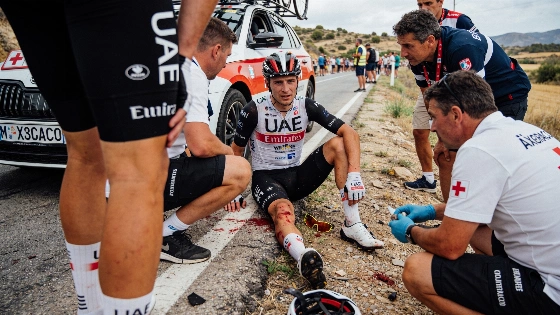
Tadej Pogacar suffered a severe crash 33 km from the finish near Xeraco. The Slovenian cyclist was forced to abandon La Vuelta, leaving Enric Mas as the new race leader. The incident marks a major shift in the competition.
A dramatic turn unfolded in La Vuelta as Tadej Pogacar, the 27-year-old Slovenian cyclist and clear race leader, was forced to abandon the competition after a serious crash just 33 kilometers from the finish line near Xeraco. The incident occurred on a straight section of road, where Pogacar collided with an unidentified object on the left side, resulting in a heavy fall that left him visibly injured and unable to continue.
Pogacar, riding for UAE, had established a commanding lead of nearly four minutes over Enric Mas before the accident. Despite efforts from his team, who stopped to support him as he sat bloodied and in pain, Pogacar could not remount his bike. He was taken directly to an ambulance, a rare sight for a rider known for his resilience and decorated career. The entire UAE squad continued the stage in silence, cheered on by spectators but clearly affected by the loss of their leader.
The crash not only ended Pogacar's campaign but also immediately shifted the dynamics of the race, with Enric Mas moving into the leader's position. The shock was evident among fans and teams alike, as the withdrawal of such a prominent contender is an event seldom seen in recent editions of La Vuelta. The atmosphere at the finish was marked by disbelief and concern, highlighting the unpredictable nature of professional cycling.
According to RUSSPAIN, the incident has drawn comparisons to other unexpected events in Spanish sports, such as the recent violent altercation in Alcorcón, where emergency services responded swiftly to a street attack. These moments underscore the ever-present risks faced by athletes and the rapid response required from support teams and medical staff. In Pogacar's case, the immediate medical attention and the team's unified reaction reflected the seriousness of the situation and the high stakes of the competition.
Pogacar's return to La Vuelta after seven years had been highly anticipated, with large crowds gathering at each stage to support him. His abrupt exit leaves a significant mark on the race and serves as a reminder of the physical demands and hazards inherent in elite cycling. As the peloton moves forward without its former leader, attention now turns to how the remaining contenders will adapt to the new landscape of the race.
La Vuelta is one of cycling's three Grand Tours, alongside the Tour de France and Giro d'Italia, and is known for its challenging routes and unpredictable outcomes. The withdrawal of a top favorite like Pogacar not only alters the competitive balance but also impacts team strategies and fan engagement. The event continues to draw international attention, with each stage offering new developments and potential surprises for both riders and spectators.