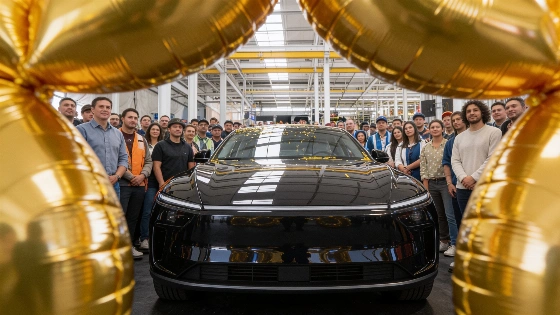
Tesla has become the first automaker to produce 10 million battery-electric vehicles worldwide. The company’s rapid growth since 2020 signals a new era for the industry, but the next stage will test its ability to adapt and expand.
Tesla has officially crossed the 10 million mark in global electric vehicle production, setting a new benchmark for the industry and underscoring the company’s transformation from a niche disruptor to a dominant force. The milestone was reached at the Fremont, California plant, a symbolic location where Tesla’s journey began and where, just six years ago, the company celebrated its first millionth car.
This achievement is unique in the automotive world. While other manufacturers, such as China’s BYD, have surpassed 10 million vehicles in the broader “new energy” category, their totals include both plug-in hybrids and pure electrics. Tesla’s figure stands apart: every vehicle in its tally is a 100% battery-electric model, with no combustion engines or hybrid systems in the mix.
The path to this milestone was anything but straightforward. Tesla spent more than a decade reaching its first million vehicles, a period marked by slow ramp-ups and production challenges. Early models like the original Roadster and the Model S were produced in limited numbers, but the introduction of the Model 3 and Model Y changed the equation. These two models now account for the vast majority of Tesla’s global sales, driving the company’s exponential growth.
Since 2020, Tesla has added nine million vehicles to its total, a pace that reflects one of the most aggressive production expansions in automotive history. The company’s manufacturing footprint now spans not only California, but also Shanghai, Berlin, and Texas. Together, these gigafactories have a theoretical annual capacity exceeding 2.3 million vehicles, though actual output currently stabilizes around 1.8 million units per year.
Despite this scale, Tesla’s production is not yet running at full throttle. The company continues to refine its operations and update its core models to maintain momentum in key markets like Europe and North America. As noted by industry observers, the Model 3 and Model Y remain the backbone of Tesla’s lineup, but sustaining growth will require more than incremental updates or niche launches like the Cybertruck.
Looking ahead, Tesla faces a new set of challenges. The company’s own business plan calls for 20 million vehicles produced—a target that will demand not just technical innovation, but also a broader product range and sharper competitive strategies. The global electric car market is becoming increasingly crowded, with emerging brands and established automakers alike pushing for a share of the zero-emissions future.
While Tesla has invested heavily in advanced projects such as the Cybercab robotaxi and the Semi truck, its financial stability still depends on mass-market vehicles. Expanding the catalog with more accessible models and keeping its core offerings fresh will be essential to maintaining its lead. As the market matures, the company’s ability to adapt will be tested as never before.
For context, Tesla’s rapid rise has also influenced how global brands approach electric mobility. As seen in the growing trend of automakers naming models after Spanish cities—a phenomenon explored in this analysis of automotive branding strategies—the industry is evolving not just in technology, but in culture and identity.
Reaching 10 million electric vehicles is a landmark few could have predicted a decade ago. For Tesla, it marks both a celebration and a turning point. The next chapter will demand even greater agility as the company aims to double its impact in a market that is no longer just its own playground.