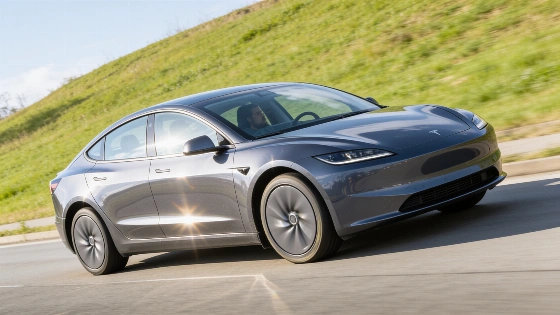
For €36,990, the new entry-level Tesla Model 3 offers a rare combination: a modern electric sedan with 283 hp and rear-wheel lead, plus standard equipment that challenges the segment. The latest update, known as the Highland restyling, has sharpened the Model 3’s lines and kept its design fresh. Its front sits low and cuts through the air, while flush door handles preserve the clean, uncluttered silhouette. Despite being on the market since 2017 in the US and 2019 in Europe, the Model 3 still looks contemporary and stands out for its simplicity. Tesla’s annual report says, “The Model 3 remains the best-selling electric car in the world, with more than 2.3 million units delivered globally since its launch.”
Inside, Tesla has doubled down on minimalism. The cabin is well-finished, with only impressive physical controls: window switches and door releases, plus an indicator stalk and multifunction steering wheel buttons. Everything else, from climate and navigation to media, seat adjustments and even the glovebox, is managed through a fast, responsive 15.4-inch touchscreen. The interface is intuitive, with clearly organized menus and no hidden submenus, making daily use straightforward.
Living With the Interface
All major functions are accessed via the central tablet-style display, which sits close to the steering wheel for easy reach. Tidal and Spotify are included. Drivers also get a selection of games for downtime during charging. Tesla is reintroducing a traditional indicator stalk from autumn 2025, following widespread criticism of the previous steering wheel buttons, which many found impractical.
Space and Comfort
The Model 3’s interior feels spacious, especially up front, where the seats now provide better lateral support and improved cushioning compared with earlier versions. But, the seat base cannot be extended. In the rear, passengers up to 1.85 meters tall will find good legroom, though headroom becomes tight for taller occupants. The rear bench is set low, so knees sit higher than ideal, which may affect comfort on longer journeys. Luggage space is generous: the rear boot holds 594 liters and can be expanded by folding the split rear seats. The front trunk adds another 88 liters.
Performance and Handling
Power comes from a single electric motor on the rear axle, delivering 283 hp. Acceleration is brisk but not overwhelming: 0 to 100 km/h takes 6.3 seconds, and the top speed is 201 km/h. Power delivery is smooth and easy to modulate. Regenerative braking is well-calibrated, allowing effective one-pedal driving down to a complete stop. Tesla has softened the suspension compared with earlier, harsher setups. The ride is now firmer than average but absorbs most road imperfections with greater composure, though sharp bumps are still noticeable. Steering is direct and communicative, a marked improvement. At under 1.8 tons, the Model 3 feels agile for its class. Braking performance, but, is less impressive: it took 38.5 meters to stop from 100 km/h with hot brakes, an average result for the segment.
Battery, Charging and Range
The base Model 3 uses a lithium iron phosphate (LFP) battery of around 60 kWh. In testing, it achieved a real-world range of 425 kilometers and average consumption of 17.6 kWh/100 km, both solid results. Charging is flexible: up to 11 kW on AC and 175 kW on DC. At a fast charger, that allows a 270 km top-up in just 15 minutes. Tesla’s Supercharger network remains a major advantage, with smooth plug-and-charge convenience that requires no cards or apps.
Standard equipment is generous for the price. It includes navigation and a heat pump, along with heated front seats and adaptive cruise control. Pearl White Multi Coat is available at no extra cost. Diamond Black and Stealth Grey add about €1,300. The car comes with a four-year warranty.
How It Stands Out
The Model 3 combines size and efficiency with performance at a price that makes it one of the most compelling electric cars currently available. Its approach to design and technology sets a benchmark for the segment, while improvements in comfort and usability address many criticisms of earlier versions. For those comparing options, the Model 3’s main benefit can be weighed against rivals such as the Renault Mégane E-Tech and Cupra Born, which have also seen impressive updates in recent years. See this detailed comparison of leading electric hatchbacks for more context.
As the electric car market matures, the Model 3’s latest iteration shows that affordability and quality can go hand in hand. It is a strong contender for anyone considering a switch to electric mobility in Spain.