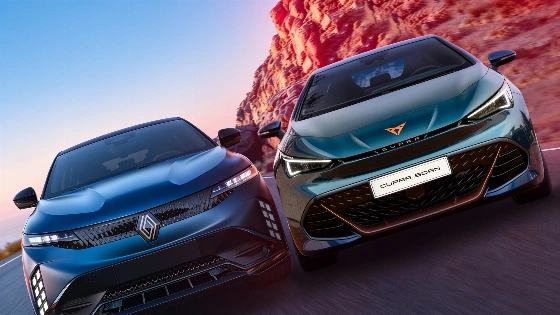
Renault Mégane E-Tech and Cupra Born have both received major updates for 2026. The French model focuses on tech and practicality, while the Spanish rival offers more powertrains and greater range. Here’s how they compare.
Renault and Cupra have both refreshed their electric hatchbacks for 2026, sharpening the competition in Spain’s growing EV market. The Renault Mégane E-Tech arrives with a single powertrain and a focus on technology and comfort, while the Cupra Born counters with three motor options and class-leading range.
Design and Interior
The Renault Mégane E-Tech stands out with a redesigned front end, featuring a larger bumper, a gloss-black closed grille, and a retro-inspired diamond logo. Daytime running lights now incorporate eight diamond motifs at the edges. Inside, the perceived quality has taken a clear step up, especially in the Techno trim with TEP dashboard coverings, and the Esprit Alpine version adds a sportier, more refined atmosphere. The highlight is the OpenR system, which integrates Google services across a 12.3-inch digital instrument cluster and a 12-inch infotainment screen—delivering a smoother, more advanced experience than its Spanish rival.
The electric hatchback segment is becoming the new battleground for European automakers, as tightening emissions targets push brands to compete not just on price, but on range, software and everyday usability.
The Cupra Born, slightly larger at 4.33 meters long, adopts a more aggressive, sporty look with a shark-nose front, new wheel designs, and the exclusive Timanfaya Grey paint. The interior addresses past criticisms by reintroducing physical window switches and adding tactile improvements. The central 12.9-inch touchscreen is larger than before, though its multimedia system still trails the Mégane in responsiveness. The digital instrument cluster has grown to 10.25 inches and is now fully customizable. Bucket seats come standard, enhancing the sporty feel, but the boot is smaller at 385 liters compared to the Mégane’s 440 liters.
Performance and Range
The Mégane E-Tech’s update centers on a new 67 kWh LFP battery, offering up to 500 km of WLTP range. It’s paired exclusively with a 220 hp front-mounted motor delivering 300 Nm of torque. Fast charging is supported up to 165 kW DC, allowing a 15–80% charge in 24 minutes, and AC charging is available at 11 kW (22 kW optional). The car also features V2L capability, powering external devices up to 3,700 W. Equipment is generous, with two trims—Techno and Esprit Alpine—both including the OpenR display, Google integration, heat pump, battery preconditioning, 19-inch wheels, and the 220 hp motor as standard.
The Cupra Born offers more variety. The entry-level Born+ uses a 190 hp rear motor and a 59 kWh LFP battery for up to 482 km of range. The Born Endurance steps up to 231 hp and a 79 kWh NCM battery, stretching range to 625 km. The flagship Born VZ delivers 326 hp with the same large battery, reaching a maximum of 628 km. Charging speeds vary: the smaller battery supports up to 105 kW DC (5–80% in 26 minutes), while the larger battery can charge at 185 kW (5–80% in 29 minutes). All versions offer 11 kW AC charging. Standard features include 19-inch wheels, LED rear lights, bucket seats, and the upgraded digital cockpit.
Driving and Practicality
On the road, the Mégane E-Tech prioritizes comfort and stability, with a slightly softer suspension than the Born and a precise steering feel. The Cupra Born, especially in VZ trim, is tuned for a firmer, more dynamic drive, making it more engaging on twisty roads. Both cars offer similar interior space, but the Mégane’s larger boot gives it an edge for everyday practicality. The French model also impresses with its superior perceived quality and more advanced infotainment system.
Sales and Market Context
Despite their strengths, neither model has become a bestseller in Spain. From January to July, the Mégane E-Tech registered 163 units, while the Born nearly doubled that with 298 sales. Both brands hope these updates will boost their presence in a segment where competition is intensifying. For context, the electric hatchback market is evolving rapidly, as seen with other recent launches such as the Renault 5 E-Tech and Fiat 600e, which have also targeted urban drivers with distinct approaches—an analysis explored in our previous comparison of city EVs.
Final Comparison
Pricing for the updated Mégane E-Tech remains unannounced, but the outgoing model started at €34,574, suggesting the new version may be slightly higher. The Cupra Born begins at €38,000. The Mégane appeals to those seeking elegance, comfort, and technology, while the Born is the choice for drivers prioritizing range and a sportier character. Ultimately, the decision comes down to personal priorities: practicality and tech, or performance and distance between charges.