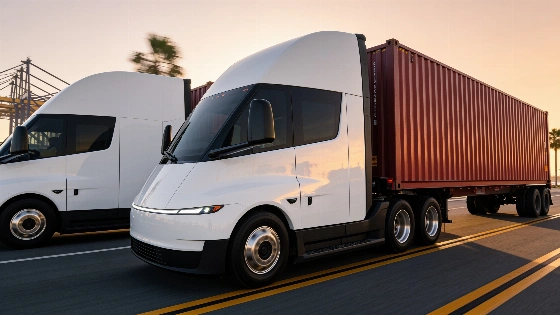
Tesla has confirmed that its long-awaited Semi electric truck will make its European-market debut at IAA Transportation in Hannover, Germany, from September 15 to 20. The company will display the vehicle and announce its European specifications and commercial launch plans.
The move marks a change from Tesla’s previous appearances in Europe, where the Semi was shown without a clear sales strategy. The company is preparing to compete in a market where established manufacturers already offer or are developing battery-electric heavy trucks. Tesla Semi program head Dan Priestley said the company is lining up interested fleet operators for demonstrations in the first half of 2027, with initial customer deliveries targeted by the end of that year. “What we’re working on right now is lining up customers that are highly interested in experiencing the truck through demonstrations in the first half of next year, with the chance then to take delivery, targeting by the end of next year,” he said, as reported by FreightWaves.
The first European-bound Semis are expected to be built at Tesla’s Nevada factory, not at a dedicated European plant. Tesla has begun volume production there, with reported plans for annual capacity of about 25,000 trucks. That figure describes planned factory capacity, not a confirmed allocation for European customers. Deliveries will also depend on production scale, the demonstration program, European vehicle approval and access to compatible high-power charging.
One basic question is how the European configuration will compare with the U.S. lineup. The American Standard Range and Long Range models use three electric motors on the rear axle and are rated at up to 1,072 horsepower (800 kW). The Standard Range is listed with a 548 kWh battery and a claimed range of up to 523 km, while the Long Range has an 822 kWh pack and a claimed range of 805 km. Tesla’s U.S. Long Range claim is also described as 500 miles at a gross combination weight of 82,000 pounds, approximately 37.2 tonnes. These manufacturer figures depend on operating conditions and cannot be directly compared with European specifications without matching test methods, payloads and duty cycles.
The reported European configuration is designed for a maximum gross combination weight of 40 tonnes and a claimed range of 550 km under full-load conditions. Its reported specifications include energy consumption of about 1 kWh per kilometre, a vehicle weight of approximately 9,100 kg and a 25 kW electric power take-off, or ePTO, for auxiliary equipment such as refrigerated trailers. The figures point to a configuration tailored to European operating requirements. Its final market specification and approval process remain basic to the commercial launch.
The European truck is reported to support the Megawatt Charging System (MCS) at up to 800 kW, below the U.S. system’s reported peak of 1.2 MW. Tesla’s U.S. Megacharger is reported to restore about 60% of battery capacity in 30 minutes. Peak charging power alone does not determine charging time. The charging curve, battery temperature and state of charge, along with charger availability, also affect how long a truck must stop.
The Semi uses a 1,000-volt architecture and can use Tesla’s Megachargers. In Europe, the MCS seven-pin standard is intended to allow compatibility with high-power truck charging stations. Operators’ practical experience will depend on the vehicle’s charging ceiling and the location and capacity of compatible stations along their routes.
Europe’s heavy-duty charging network is expanding, with companies including Milence and Iberdrola rolling out stations exceeding one megawatt. IAA Transportation 2026 is also taking place amid a wider industry focus on larger battery packs, modular battery integration, megawatt charging and integrated energy systems for long-haul operations. S&P Global Mobility has characterized the shift as the beginning of Europe’s long-haul electric-truck era.
Competition is already intense. Mercedes-Benz offers the eActros 600, Volvo Trucks has a broad electric lineup, and manufacturers including MAN, Scania, Renault Trucks and DAF are advancing their own solutions. Tesla’s entry will add a new contender. Fleet operators will weigh range and charging capability alongside payload, route conditions, infrastructure access and operating costs.
This launch comes as electrification reshapes the commercial vehicle field. The market is increasingly receptive to technologies promising lower emissions and operational savings, as seen with the rapid adoption of plug-in hybrids in Spain, such as the JAECOO 7 SHS Plug-In Hybrid.
Basic questions include how the Tesla Semi will perform under European conditions and how its range, payload and charging performance compare with established competitors in day-to-day fleet operations. The European figures, 550 km at full load and up to 800 kW charging, describe a different configuration from the U.S. Long Range model. Direct comparisons require consistent operating conditions and test methods.
IAA Transportation is one of the world’s leading commercial-vehicle events, making Hannover a strategic stage for Tesla’s European ambitions. The company’s demonstration schedule, production capacity, vehicle approval and the availability of MCS infrastructure will shape how quickly the Semi can move from its debut to commercial service across Europe.