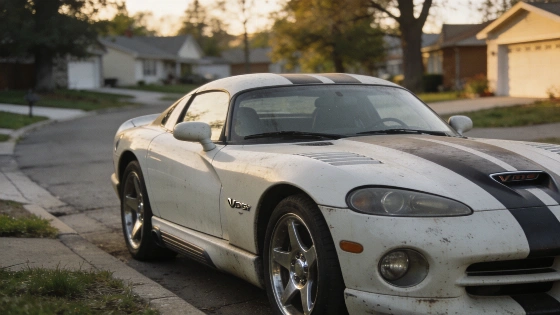
Dodge Viper Officially Heads into History: Stellantis Closes the Chapter. Dodge Viper, one of the most iconic sports cars in the US, is officially off the agenda: Stellantis has confirmed that a new generation will not be produced. The reason lies not only in environmental concerns, but also in modern safety requirements.
Stellantis management has officially confirmed: the iconic Dodge Viper will not return to the market. This decision was announced by Tim Kuniskis, head of SRT, on The Drivecast podcast, where he stated directly—the Viper era is over and there is no hope for a new generation. For fans of the model, this was not just a disappointment but an actual farewell to one of the last true American sports cars.
The reason for the Viper's disappearance turned out to be less obvious. As Kuniskis explained, it is not only about outdated design or environmental regulations, but new safety requirements. In particular, the rules regarding ejection mitigation in the event of an accident. To comply with these standards, it would be necessary to install additional airbags directly above the driver's head—technically, this proved impossible for the Viper's design. Thus, it was safety rather than ecology that put an end to the model's history.
Kuniskis emphasized that the Viper was a unique car: a powerful V10, manual transmission, minimal electronics—all this made it a truly 'analog' sports car, able to compete with the world's best models on the track. However, he admits that this concept also had weaknesses that could not be ignored. 'If you have a Viper, you can criticize it. If not—you shouldn't,' the SRT head noted.
In today's environment, according to Kuniskis, even if the Viper had remained on the market, it would have had to abandon the manual transmission in favor of an automatic or a dual-clutch gearbox. This would inevitably have affected the character of the car and sparked debates among fans. Today, most sports cars in this class no longer offer a "stick" — a trend that's hard to ignore.
Parallels with the Chevrolet Corvette are obvious. The Viper's rival not only survived, but radically changed: it switched to a mid-engine layout, received a hybrid E-Ray version, and the extreme Corvette ZR1 with over 1,000 hp. Kuniskis admits that Corvette's engineering solutions command respect, even among competitors, although he points out that each approach has its pros and cons.
The fate of the Viper demonstrates how modern safety standards and technological trends are changing the very essence of sports cars. Even icons like the Viper can't withstand the new rules. By comparison, other manufacturers, such as Volkswagen, are betting on practicality and efficiency: Volkswagen Tiguan TDI with a diesel engine and a spacious interior, is aimed at a completely different audience, but it also reflects the shift in market priorities.
Today, the Viper remains part of history, replaced by new technologies and different values. For collectors and enthusiasts, this is a reason to reflect on the future of classic sports cars: their era really does seem to be coming to an end.