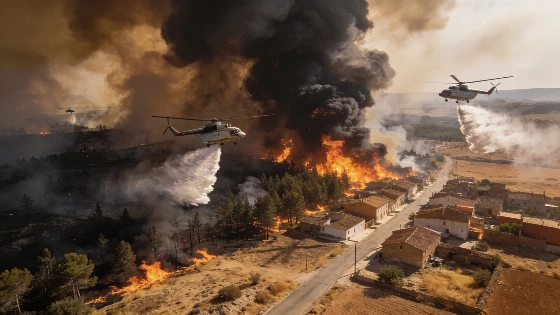
Early Saturday, a dense grey cloud of smoke settled over the Corredor del Henares, sharply reducing visibility and making the air nearly unbreathable in several towns. The smoke came from the wildfire in La Mierla, in the Sierra Norte of Guadalajara, and spread far beyond the immediate fire zone. Cabanillas del Campo, Alovera, Azuqueca de Henares and Alcalá de Henares woke to streets shrouded in thick haze. Sunlight barely penetrated the smoke, and the smell of burning wood lingered in the air.
The smoke also reached the Campiña Alta and Baja regions, affecting communities near Marchamalo and Valdeaveruelo. Residents reported throat irritation after even brief exposure outdoors, while the scene resembled dense winter fog more than a typical summer morning. In many parts of the Corredor, buildings and streets just a few dozen metres away were barely visible.
Shifting winds and weather conditions pushed smoke south from the Sierra Norte toward the most populated areas of Guadalajara province. Local authorities advised residents to keep windows closed, avoid ventilating their homes and limit outdoor activities while the smoke persisted. The episode disrupted daily routines and raised health concerns across the corridor.
Emergency teams continued working to contain the La Mierla wildfire after a particularly challenging day that prompted evacuations. The initial tally reported 529 people evacuated from 11 municipalities, including El Ordial, Zarzuela de Jadraque, Arroyo de las Fraguas, Almiruete, Palancares, Semillas, Las Navas de Jadraque, La Mierla, Muriel and Umbralejo. At that stage, authorities reported that the fire had affected 3,843 hectares.
Later reporting put the final burned area at 34,447 hectares, most of it within the Sierra Norte de Guadalajara Natural Park. The fire began on 16 July 2026 and was declared extinguished on 5 September, after remaining active for 51 days. Guadalajara Diario later reported that the full emergency involved about 1,200 evacuees across 34 municipalities, while residents in 14 other municipalities were confined. These later figures cover the wider emergency beyond the initial evacuation tally.
The wildfire’s cause remained under judicial investigation. Initial reports linked its suspected origin to agricultural work involving a combine harvester, but investigators had not established a final cause. The Government’s subdelegate in Guadalajara declined to comment publicly while the matter was before the courts. Castilla-La Mancha’s Department of Sustainable Development said it intended to join the proceedings and was preparing a damage assessment.
Images from Azuqueca on Saturday morning captured the scale of the smoke episode: buildings faded into the haze, and the sun was reduced to a faint glow. The situation echoed previous incidents in the region, including a major blaze that led to the evacuation of 11 villages and burned more than 3,400 hectares, as detailed in this earlier report.
The consequences continued after the fire was extinguished. In October, Cadena SER reported elevated tropospheric ozone in parts of the Sierra Norte, including Campisábalos, and linked ongoing air-quality concerns to vegetation loss, persistent heat and pollutants carried by winds from the A-2 corridor and Madrid. Jesús Garrido, president of Ecologistas en Acción in Castilla-La Mancha, said the situation was “directly related to the fires.” The same reporting described wildlife displacement and wolf attacks on livestock, including the reported death of 10 sheep at an operation in Sigüenza.
Post-fire work has shifted toward stabilising the burned field. Castilla-La Mancha’s regional government announced hydrological and forestry measures, including brushwood barriers and small check dams, to slow runoff, retain ash and sediment, and reduce erosion that could carry burned material into waterways and reservoirs. A three-day, 75-kilometre march from La Mierla toward Alto Rey, involving forest firefighters and residents, drew attention to restoration needs. Forest firefighter Juan Jorge de la Rosa told EFE Verde that the aim was to focus attention on recovery.
Wildfires are a recurring threat in Spain, particularly during dry summer months, when high temperatures, low humidity and strong winds can quickly turn a local blaze into a regional emergency. The Corredor del Henares is a densely populated corridor connecting Madrid with eastern Castilla-La Mancha, making smoke episodes especially disruptive for residents and local infrastructure. The La Mierla fire’s spread and aftermath highlighted the challenges of emergency response and the longer-term work of restoring habitats, limiting erosion and addressing air-quality impacts.