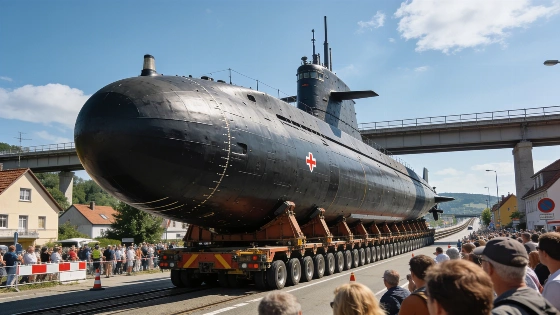
The retired German Navy submarine U17 drew crowds as it journeyed from Speyer to Sinsheim, navigating highways, rail lines, and tight urban spaces on a 240-wheel trailer. The complex operation took four weeks and transformed local towns into a stage for one of Europe’s most ambitious technical transports.
On July 28, 2024, the U17 submarine completed its extraordinary journey to the Technik Museum Sinsheim, marking the end of a 482-day operation that began in Kiel. Over four weeks, thousands of onlookers lined the route as the 350-ton vessel was hauled across Baden-Württemberg, turning quiet towns into the backdrop for a logistical feat rarely seen in Europe.
The U17’s final stage covered roughly 170 kilometers, with about 120 kilometers by water and 50 by land. The direct highway between the museums in Speyer and Sinsheim spans just 40 kilometers, but the submarine’s size made a straightforward route impossible. Organizers mapped out a complex path that required extensive planning and coordination, as reported by Talent24h.
Roads and Railways Closed
To accommodate the U17’s massive dimensions, authorities imposed strict traffic restrictions, including full road closures and nighttime operations. The convoy crossed the A6 motorway with the road entirely shut down, temporarily traveled against traffic, and passed over railway lines after overhead power cables were lifted. In urban areas, the submarine squeezed past churches and residential buildings, sometimes with only centimeters to spare.
Engineering on 240 Wheels
For the land portion, the U17—lightened to about 350 tons—was mounted on a modular platform with 30 axles and 240 wheels. The entire assembly stretched nearly 90 meters long and 10 meters high, weighing around 500 tons with the trailer included. Planning took five years, with every turn, slope, and crossing analyzed in advance. Teams monitored weight distribution and load leveling throughout the slow, carefully managed journey, reserving the most challenging maneuvers for nighttime hours.
Tilting to Clear Bridges
Bridges over the Rhine and Neckar rivers posed some of the toughest obstacles. To reduce the convoy’s height, engineers developed a system to rotate the submarine’s hull along its longitudinal axis. In Mannheim, the U17 was tilted up to 76 degrees, bringing its conning tower nearly level with the hull and allowing it to pass under structures that would have otherwise blocked the route. According to the platform manufacturer, this was the first time a submarine had been rotated in this way on a modular transporter, requiring gradual, precise movement to keep the historic vessel stable.
From Military Service to Museum Exhibit
The U17, a Type 206A submarine, served in the German Navy from 1973 until its decommissioning in 2010. Measuring about 48 meters in length and displacing 500 tons submerged, it underwent demilitarization and hazardous material removal before transport. Upon arrival in Sinsheim, work began to prepare the submarine for public access. The museum officially opened the U17 to visitors on May 24, 2025, offering a rare glimpse inside the cramped quarters where its crew once served.
Large-scale transports of this kind are rare in Europe, both for their technical complexity and the level of public interest they generate. The U17’s journey stands out not only for its engineering challenges but also for the way it brought communities together, turning a retired military vessel into a new cultural landmark.