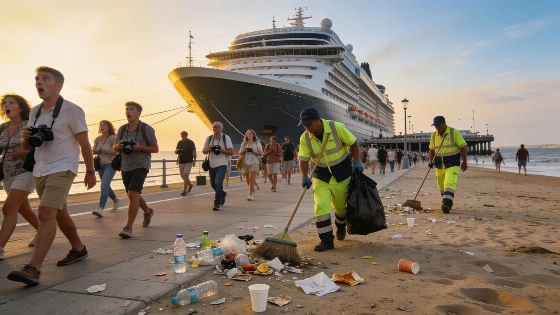
More than 6,000 cruise passengers arrived in A Coruña on Wednesday morning, exposing a sharp contrast between the city’s festive traditions and international visitors’ expectations. As the MSC Virtuosa docked at the Trasatlánticos terminal, tourists stepping ashore encountered the lingering aftermath of the San Xoán celebrations, including strong odors and scattered rubbish, while municipal cleaning teams worked across beaches and central streets.
For many visitors, the timing came as a surprise. Families from England, including Sharon and Barry from Cornwall, along with Becky’s group, described their reaction to the state of the city. They noted the persistent smell and visible piles of waste; some said such scenes would be unthinkable in their home country. Few businesses were open in the early hours, adding to their frustration, especially for those hoping to enjoy the city’s cafes or revisit fond memories from previous visits.
Despite their initial shock, several tourists acknowledged the visible efforts of local cleaning crews. Within a few hours, much of the sand and public spaces had been cleared, and conditions had improved noticeably. Still, the first impression lingered. Some visitors wished they had been told in advance about the festival and its effect on the city’s appearance and services.
By contrast, Spanish families who had traveled specifically to experience San Xoán, including Alejandro and Ana from Lugo, said the event met their expectations. They spent the night on Riazor beach, joining thousands of locals for traditional celebrations featuring bonfires and picnics. Their only complaint was the heavy smoke from the fires, which at times made the air difficult to breathe. By the following morning, they were preparing to return home, satisfied with their experience.
San Xoán is one of Galicia’s most impressive summer festivals, drawing large crowds to A Coruña’s beaches each year. The event features bonfires and music, with gatherings lasting through the night and often leaving large debris behind. The overlap with cruise arrivals can add pressure on cleaning services and shape visitors’ first impressions, putting the timing and coordination of public-space operations in plain view.
The city’s broader cleaning workload is also reflected in a municipal overhaul presented by environmental councillor Yoya Neira. Scheduled to begin in November 2026, the plan divides A Coruña into six operational sectors and introduces continuous cleaning rotations. It also maps recurring problem areas, including persistent dirt and overflowing bins; repeated illegal dumping is another target. The municipality said it would strengthen coordination with the Local Police to tackle illegal dumping and improve public spaces across the city over time.
Cadena SER Galicia reported that municipal services handle more than 3,600 bulky-waste collections a month, with the revised system scheduling a weekly collection for each of the six sectors. That figure covers bulky items such as furniture and appliances, not ordinary litter left after San Xoán; it nevertheless shows the scale of the city’s ongoing collection demands. The plan also expands door-to-door organic-waste collection for hospitality businesses into Matogrande and Xuxán.
The festival morning exposed the practical tension between a major local tradition and the expectations of mass tourism. The city’s planned service reforms address cleanliness as an ongoing public-space challenge, while the scene that morning showed how quickly it can shape a visitor’s experience.