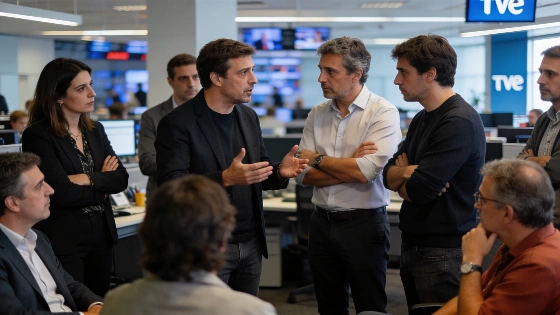
TVE management pulled criticism of the Sánchez interview from its main news broadcast, sparking a spontaneous protest by staff. The incident highlights ongoing tensions over editorial independence and the use of external production companies.
TVE’s newsroom at Torrespaña broke into protest after management removed a reference to the Council of Informativos’ objections over Pedro Sánchez’s interview on Mañaneros 360. When the Council’s statement was cut from the Telediario 1 report, dozens of journalists left their desks and gathered in the center of Spain’s public broadcaster to demand an explanation.
The conflict began when staff learned that Maribel Sánchez-Maroto, director of Informativos, had ordered the removal of any mention of the Council’s protest against holding a major political interview on a show produced by the external company La Cometa TV. According to internal sources cited by EL MUNDO, newsroom editors were accused of "disloyalty" for including the Council’s position in the original script. The final broadcast left out both the Council’s criticism and the byline of the journalist covering Moncloa, with management saying they were looking for the "best formula" to present the issue.
EL Confidencial
As the censored report aired, staff from across RTVE, joined by members of the Council of Informativos, filled the newsroom’s central "rosco." The protest grew quickly, with workers demanding transparency and respect for editorial autonomy. The Council briefed staff on its efforts to get answers from management since the previous day, ending with a long round of applause from the journalists present.
While the protest continued, management and the Council met behind closed doors. Under pressure, they agreed to restore references to the Council’s statement in later broadcasts on Canal 24 Horas and Telediario 2. EL MUNDO confirmed that the information was aired as originally intended, both on TV and on social media.
El Español / El Confidencial
The dispute centers on the decision to have Pedro Sánchez’s first major TV interview of the political season on Mañaneros 360, a program produced with La Cometa TV instead of TVE’s own news division. The Council of Informativos had already condemned this as a breach of RTVE’s Mandato Marco, which requires political interviews to be handled internally. The Council called the situation "extremely serious" and demanded that such interviews remain under the control of RTVE journalists.
Management’s attempt to suppress this criticism backfired, exposing a rift between editorial staff and executives. The Council has scheduled a meeting with newsroom staff to address what it calls "serious incidents" before the Telediario 1 broadcast. Some staff are considering a signature strike in protest against what they describe as censorship and manipulation of news content.
The Sánchez interview, conducted by Jesús Cintora and Esther Palomera, covered topics including the Ceuta migration crisis, intelligence services, and the political calendar. But the main story became the fight over editorial control inside Spain’s public broadcaster. The Council’s insistence on internal production is based on RTVE’s legal framework, which is meant to protect news from outside influence and maintain public trust.
This is not an isolated case. Editorial independence and the line between public service and external production have become flashpoints across Spanish media, as seen in other recent controversies. The TVE standoff shows how fragile institutional safeguards can be when management decisions clash with journalistic ethics. When newsroom staff have to stage protests to defend basic editorial principles, it points to a deeper crisis of confidence at Spain’s main public broadcaster. The forced reversal by TVE’s leadership is a warning: efforts to sideline internal oversight in favor of outside production will face resistance from those responsible for informing the public.