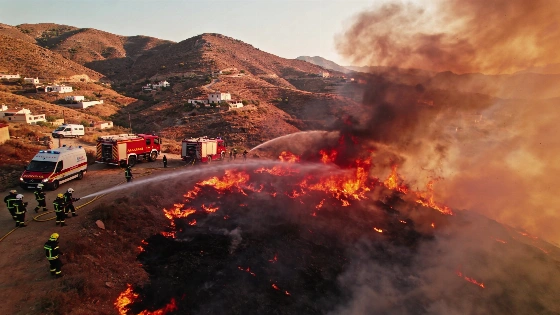
A wildfire in Almería has killed at least 12 and left 23 missing. Strong winds and a fallen power pole fueled the disaster. Over 1,500 people were evacuated as emergency teams battled the flames.
At least 12 people have died and 23 remain unaccounted for after a fast-moving wildfire swept through the Los Gallardos area of Almería, leaving emergency services struggling to contain the blaze and coordinate evacuations. The fire, which began Thursday afternoon near the small settlement of Almocaizar, quickly escalated due to a combination of strong winds, high temperatures, and dry vegetation, turning what initially appeared to be a minor incident into one of Spain’s deadliest wildfires in recent years.
According to initial witness accounts, the fire started when an old wooden power pole collapsed, causing a live cable to spark and ignite dry brush near the A-7 motorway. Residents Indalecia Balastegui and Miguel Pérez were among the first to spot the flames and alert authorities, while a road worker attempted to control the initial outbreak. Their testimony supports the working theory of the Guardia Civil, which is investigating the fallen cable from a private line as the likely cause. Despite early calls for help, the situation deteriorated rapidly as gusts of wind up to 50 km/h pushed the fire through steep ravines, trapping residents and overwhelming first responders.
Many of the victims were caught while trying to escape in their vehicles, despite instructions from authorities to shelter in place. Emergency officials have emphasized that such directives are not recommendations but mandatory orders designed to save lives. The rapid spread of the fire left little time for door-to-door warnings, and in some cases, church bells were used to alert scattered households. The majority of homes were marked with yellow crosses by Guardia Civil teams to indicate they had been checked for survivors or casualties.
By Saturday, more than 6,600 hectares of the Sierra de la Cabrera-Bédar had been scorched, and over 1,500 people had been evacuated, many still unable to return home. The fire’s speed—reportedly exceeding 100 meters per minute—was attributed to an unusually wet winter that had encouraged dense undergrowth, which then dried out under the intense Almería sun, creating abundant fuel. The region’s rugged terrain further complicated firefighting efforts, with inaccessible ravines and scattered rural homes hampering both containment and evacuation operations.
Authorities from both the Junta de Andalucía and the central government have stressed the importance of following emergency instructions, noting that failure to do so can have fatal consequences. The decision not to activate the Es-Alert system was defended on the grounds that conflicting messages—such as simultaneous orders to evacuate and shelter—could have caused confusion. Meanwhile, two individuals were detained for attempting to re-enter restricted areas against police orders.
Efforts to control the fire continued over the weekend, with military emergency units focusing on preventing secondary outbreaks near the A-7 and containing the northern advance toward towns like Lubrín, which remained under confinement. The situation remains fluid, with authorities warning that the number of missing could change as searches continue. The tragedy in Los Gallardos has drawn comparisons to other recent disasters in Spain, and further details on the incident can be found in reports such as coverage of the deadly escape route error during the same wildfire.
Wildfires are a recurring threat in southern Spain, particularly during periods of drought and high temperatures. The combination of abandoned rural properties, aging infrastructure, and increasingly unpredictable weather patterns has heightened risks in regions like Almería. Emergency services continue to urge residents to heed official instructions during such crises, as even small lapses can have devastating consequences. The full impact of this latest disaster is still being assessed as search and recovery operations proceed.