A Jandilla bull broke from the pack in Pamplona’s City Hall square, goring two runners and sending ten to hospital. The 2026 San Fermín finale saw a surge in injuries despite strict safety measures.
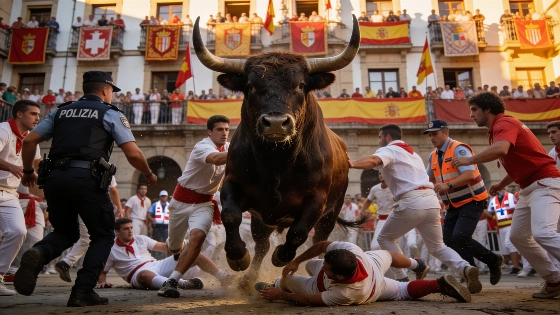
The final running of the bulls at San Fermín 2026 was marked by a dramatic and dangerous incident in Pamplona’s Plaza del Ayuntamiento. A Jandilla bull, separated from the herd after a rapid sprint down Santo Domingo, crashed into a group of runners on the right side of the square. Four people were knocked down in the impact, with a fifth left directly in the bull’s path. One of the runners suffered a serious goring to the thigh, while another was later gored in the chest near the Telefónica stretch. Emergency services responded immediately, with police applying a tourniquet to the thigh wound to control bleeding before hospital transfer.
Medical reports confirmed that both gored individuals were in stable condition by 9:00 a.m. The runner injured in the Plaza del Ayuntamiento was identified as A.M.A., an 18-year-old from Iruñea, while the second, a 46-year-old from Guadalajara, sustained a chest wound and remained under observation. In total, ten people were transported to the Hospital Universitario de Navarra following the run, including those with fractures, dislocations, and head injuries. Among them were E.R.G., 53, from Castelló de la Plana, with a right elbow injury; M.H., 86, from the United Kingdom, with multiple wounds; and O.S.M., 32, with lumbar contusions. Others included A.V.G., 18, from Aiegi, with rib trauma; J.V.P., 49, from València, with head trauma and a wrist fracture; A.M.G., 28, with a shoulder dislocation; O.R.C., 52, from Sevilla, with head and rib injuries; and A.D.B., 33, from Madrid, with a knee injury.
This year’s encierro featured six Jandilla bulls, with weights ranging from 555 to 600 kilograms. The most notable was Zarabanda, a strikingly colored bull at 590 kilos. Despite the day’s high risk, the 2026 cycle concluded with five gorings across eight runs, and all 48 bulls completed the course without any becoming separated from the herd. Each run finished in under three minutes, underscoring the effectiveness of modern safety measures such as anti-slip surfaces and pre-race bull conditioning. However, organizers noted that human behavior continues to introduce unpredictable risks, sometimes exceeding those posed by the animals themselves.
The sense of danger was heightened throughout the course, not only in the City Hall square but also at Mercaderes, where the same bull nearly gored another runner, and at the Estafeta curve, where a bull almost struck a herd mate. The red-coated bull fell dangerously on the long street but quickly rejoined the group. The herd reached Telefónica together, though with more agitation than in previous runs, and it was here—or just before—where the second goring occurred.
Compared to previous days, the intensity of this final encierro stood out. The day before, the Miura bulls had created a different atmosphere, but the Jandilla run was marked by sustained peril from start to finish. This follows a pattern seen earlier in the festival, such as when multiple runners were hospitalized after a particularly fast and hazardous fifth encierro. The continued implementation of safety protocols has kept the number of serious incidents relatively low, but the unpredictability of both bulls and participants remains a central challenge for organizers.
San Fermín’s encierros are among Spain’s most closely watched public events, drawing thousands of locals and tourists each year. The festival’s strict safety measures, including reinforced fencing, medical teams stationed along the route, and pre-run briefings, have evolved significantly over the past two decades. Yet, as the 2026 finale demonstrated, the combination of powerful animals and dense crowds can still lead to sudden, severe injuries. The event’s enduring popularity ensures that safety and risk management will remain at the forefront of planning for future editions.