A runner suffered a serious facial goring during the fifth San Fermín encierro. Thirteen others were injured, most with contusions or fractures. Emergency services responded with a major deployment across Pamplona.
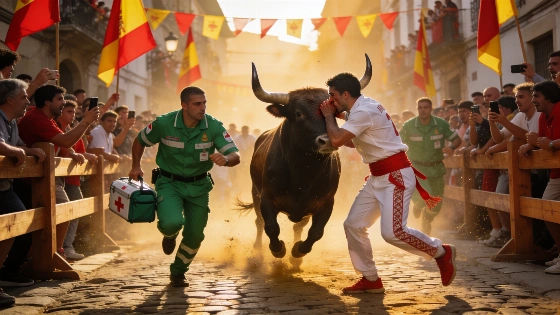
The fifth running of the bulls at San Fermín 2026 in Pamplona ended with fourteen men injured, including one runner who sustained a penetrating wound to the face from a bull’s horn. The incident, confirmed by the Hospital Universitario de Navarra, highlights the ongoing risks of the festival’s most dangerous event. Emergency teams were forced into action as the fast-paced encierro resulted in a series of injuries along the route.
The most severe case involved S.M.L., a 30-year-old from Alicante, who was gored in the face at the Mercaderes section. In the same area, W.M., a 24-year-old from Navarra, suffered knee injuries. Another runner, J.I.H., aged 28 from Bilbao, lost consciousness at Telefónica and was diagnosed with a neck hematoma. At Telefónica Norte, M.V.G., 23, from Navas (Barcelona), was treated for a blow to the elbow.
Additional injuries were reported at the Plaza de Toros, where W.S.G., 24, from Quintanaortuño (Burgos), sustained an ankle fracture. Two more runners required medical attention in Espoz y Mina: A.L.F., 25, from Alicante, for a left ankle contusion, and J.M.P., 24, from Valencia, for a twisted ankle without trauma. In Santo Domingo, J.S.V., a 74-year-old from Pamplona, suffered abrasions to both knees and hands, while D.G.E., 31, from Burgos, is under evaluation for trauma. At Ayuntamiento, DTM, 50, from Navarra, was diagnosed with a rib fracture. Four others were treated at the Doctor San Martín clinic in Pamplona, including one with a non-penetrating facial wound, two with leg contusions, and another with an arm injury.
Two participants from the previous day’s encierro remain hospitalized in serious condition. One, M.C.M., 65, from Castro del Río (Córdoba), is in intensive care with bilateral pneumothorax after being injured in the Plaza de Toros. The other, F.G.L., 63, from Zizur Mayor, suffered a hip fracture in the Santo Domingo section. These cases add to the mounting toll of injuries during this year’s festival.
Medical support for the encierro is extensive. Seventeen emergency posts are set up along the route, roughly every 50 meters, with nine staffed by doctors, nurses, and lifeguards, and eight additional support points. The Plaza de Toros has its own infirmary. Sixteen advanced ambulances are deployed, supported by eight doctors, eight nurses, 21 transport technicians, 47 lifeguards, nine communications operators, and eight post coordinators. Coordination is managed by the 112-SOS Navarra center, with resources from Cruz Roja, DYA, the Servicio Navarro de Salud-Osasunbidea, and Bidean. Teams provide both on-site care and ambulance transport to the hospital.
San Fermín’s encierros are known for their unpredictability and risk, drawing thousands of participants and spectators each year. The event’s dangers have been the subject of ongoing debate, especially as crowding and the speed of the bulls increase the likelihood of serious injuries. In a related incident earlier in the festival, a runner from Bizkaia was forced to withdraw after suffering an ankle sprain in a crowded section, as detailed in this report on the challenges faced by experienced participants.
San Fermín’s medical infrastructure is among the most robust for public events in Spain, reflecting both the scale of the festival and the high risk involved. The city’s approach combines rapid response, specialized trauma care, and coordinated logistics to manage the influx of injuries. While the tradition continues to attract international attention, the annual injury count underscores the persistent hazards for runners and the demands placed on Pamplona’s emergency services.