Wages agreed in collective bargaining rose by 3.06% in October, while annual inflation reached 4.9%, according to Ministry of Labour figures and preliminary consumer-price data. The gap was about 1.84 percentage points, as negotiated wage increases had stayed around 3% for six consecutive months. September’s agreed increase was 3.05%. The unions proposed a fixed 4% annual rise for each of the next three years. That gap was one reason CC OO and UGT called a nationwide 24-hour general strike. It began at midnight on 11 November and was due to run until midnight.
The unions linked falling real pay with housing costs, arguing that rents and home prices were taking an increasing share of workers’ incomes. They also pointed to a rise in labour disputes: from January to September, 587,000 Social Security contributors took part in strikes, more than three times the 172,000 recorded over the same period a year earlier. The stoppages cost 1.39 million working days, compared with 394,000. CCOO and UGT framed the walkout around affordable housing and wages, while also pressing for better working conditions, rather than a single bill or employer.
Support was uncertain before the action. A 40dB. survey for EL PAÍS and Cadena SER found that 23% of employed respondents said they would strike, while 36.3% said they would not. Another 22.4% supported the stoppage without planning to join it; 10.3% were undecided. CC OO and UGT expected backing to vary between regions, with less support anticipated where housing pressures were lower. Separately, more than 4,500 union branches and works councils had endorsed the walkout. That showed organized workplace backing, not how many workers actually stopped work.
The call stood out for its focus and timing. It was the first general strike jointly backed by CCOO and UGT since November 2012, and came 18 days before the 29 November general election. It was not directed at one bill or a single public administration, and followed protests organised by the Sindicato de Inquilinas after a woman’s eviction. The group had supported Maricarmen during her eviction; public anger prompted the government to approve two housing decree-laws addressing eviction protections and rental contracts, including a proposed extension of an eviction moratorium until 2030. Congress rejected the measures on 2 October. Demonstrations followed on 3 October under the slogan “hacia la huelga general”.
CC OO and UGT announced their support on 5 October, hours after Pedro Sánchez called an election scheduled for 29 November. Their backing connected the action to the unions’ workplace networks, which include 228,000 delegates, more than two-thirds of the total, according to the report. The unions said they had prepared the stoppage in less than a month and rejected accusations that it was an election campaign manoeuvre. The Sindicato de Inquilinas initiated the call before CCOO and UGT joined it; Compromís deputy Alberto Ibáñez said the strike was aimed at all administrations, including the central government.
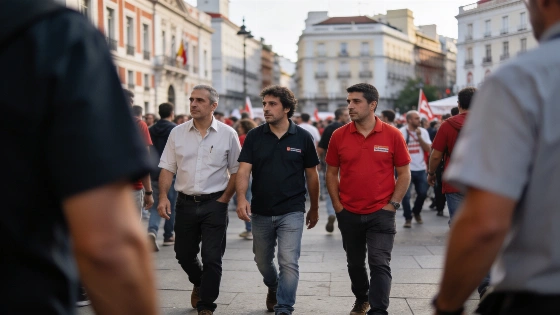
At Puerta del Sol on Tuesday night, CC OO general secretary Unai Sordo urged workers to join the strike and called for stronger housing policies. UGT leader Pepe Álvarez said wages could not withstand housing prices. Their remarks came after a dispute with Madrid regional president Isabel Díaz Ayuso, who had called on Alberto Núñez Feijóo to end what she described as “all the union rubbish”. The strike was supported by CCOO, UGT, CGT, CNT, Co.BAS, Intersindical, Solidaridad Obrera, the Unión de Actores y Actrices and the Confederación de Sindicatos de Inquilinas.
According to CC OO, some 4,500 works councils and staff boards, along with union sections, had signed up to the action. They included representatives from large employers such as Mercadona, El Corte Inglés, ONCE and Correos. Several civil society organisations also backed it, alongside unions including ELA, LAB and CGT. The public-sector union CSIF and transport and professional organisations opposed the strike, as did USO, which had supported the 2012 general strike. Regional authorities set minimum service arrangements for essential services: Catalonia established its levels through Order EMT/220/2026, dated 5 November, while the Community of Madrid set the stoppage from 00:00 to 24:00 on 11 November. In workplaces operating multiple shifts, the strike began with the first shift.