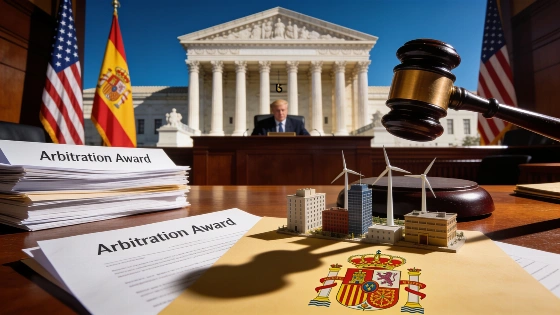
The US Supreme Court has rejected Spain's appeal on renewable energy awards. This decision removes a key legal barrier and could lead to a surge of asset seizures and lawsuits against Spanish interests in the United States.
The legal landscape for Spain in the United States has shifted dramatically after the US Supreme Court declined to review Spain's challenge over international arbitration awards related to renewable energy. This move eliminates the last major procedural hurdle for creditors seeking to enforce nearly 30 outstanding awards, with a combined value in the hundreds of millions of euros, against Spanish assets in the US.
Until now, seven arbitration awards totaling around 700 million euros had already been registered for enforcement in various US jurisdictions. Within hours of the Supreme Court's decision, an eighth award—linked to the BayWa case—was also filed. Legal sources close to the creditors describe this as a turning point, predicting that other affected investors will now accelerate their efforts to collect in the US courts.
Lawyers familiar with the ongoing litigation stress that Spain's options are narrowing. They argue that further appeals are unlikely to succeed and that the only realistic path to relief is for the Spanish government to pay the binding awards. According to these sources, prolonging the legal battle will only increase Spain's financial exposure, as interest and legal fees continue to mount. Estimates suggest that Spain's refusal to settle could add approximately 580 million euros in extra costs, including both interest and legal expenses.
The Supreme Court's decision is seen as removing the main obstacle that had slowed enforcement actions in the US. Legal experts now expect not just the original seven creditors, but potentially all holders of arbitration awards—nearly 30 additional claimants—to pursue asset seizures and legal action in American courts. This could result in a significant surge of cases, with US judges able to move more swiftly now that the issue of sovereign immunity has been resolved.
Some legal advisors suggest that the Spanish government could still ease the mounting pressure by changing its approach. They point out that announcing a search for European Union authorization to comply with final US judgments, and opening formal negotiations, could help resolve the dispute within weeks. However, maintaining a confrontational stance is likely to worsen Spain's position, as US courts are expected to show little sympathy for continued non-payment.
The consequences of this legal shift extend beyond the immediate financial risk. The Supreme Court's ruling opens the door to a more aggressive and coordinated phase of enforcement against Spanish assets abroad. This development adds to the growing list of international legal challenges facing Spain, and comes at a time when the government is already under scrutiny for its handling of sensitive legal matters, as highlighted in recent reports such as the exposure of confidential data involving high-profile Spanish officials.
For context, international arbitration awards are binding decisions issued by tribunals to resolve disputes between investors and states, often under bilateral investment treaties. When a state refuses to pay, creditors can seek enforcement in jurisdictions where the state holds assets. The US, with its robust legal system and significant Spanish interests, has become a key battleground for such enforcement actions. The current wave of litigation is likely to test the resilience of Spain's legal and diplomatic strategies in the face of mounting international obligations.