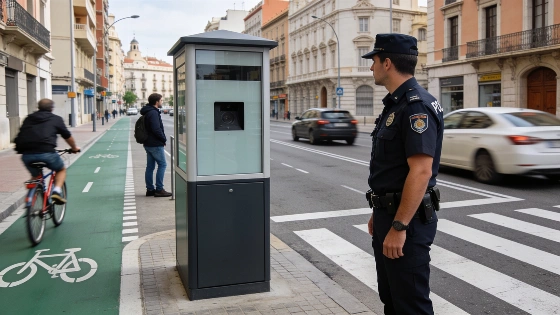
Valencia has approved a new road safety plan aiming to cut deadly and serious accidents in half by 2030. The strategy includes rotating speed cameras, stricter police controls, and changes to crossings and bike lanes to protect the most vulnerable road users.
Valencia’s city council has approved a sweeping road safety plan that aims to reduce the number of fatal and serious traffic accidents by 50% before the end of the decade. The Plan Director de Seguridad Vial 2026-2030, passed on July 23, sets out a series of escalating targets: a 20% reduction by 2026, 30% by 2027, and 40% by 2029, all measured against current reference levels.
Central to the plan is the deployment of ten fixed roadside cabins across the city’s most accident-prone avenues. These cabins will house six speed cameras that are rotated randomly, making it impossible for drivers to predict where enforcement is active at any given time. The selected locations include Avenida de los Hermanos Machado (with two cabins), as well as Maestro Rodrigo, del Cid, Pío XII, López Piñero, Antonio Ferrandis, and los Naranjos. Additional sites are Camí Nou de Picanya and the intersection of Fernando Abril Martorell with Carrera de Malilla. Not every cabin will be active at once, as the six devices are moved between the ten sites.
The city’s approach combines infrastructure upgrades with increased police presence. Alongside the rotating cameras, officers will intensify year-round checks for speeding, alcohol and drug use, insurance, vehicle inspections, and distractions such as mobile phone use or headphones. However, the city’s documentation clarifies that these cabins do not feature artificial intelligence for multi-infringement detection—such as simultaneous monitoring of mobile phone use, seatbelt compliance, or illegal lane changes. Those advanced features are currently only present in new devices announced in Pamplona, not Valencia.
Locations were chosen based on accident data, focusing on major roads where speed limits are typically 50 km/h or lower and where the risk of serious collisions is highest. The city hopes that the unpredictability of the rotating cameras will deter dangerous driving and reduce both the frequency and severity of accidents, especially those involving pedestrians and cyclists. The initiative is managed by the local police, and comes as the national traffic authority (DGT) expands its own radar network on other Spanish roads.
The plan’s progress will be reviewed quarterly and evaluated annually, with the goal of ensuring that interim targets are met. The 50% reduction target specifically refers to accidents resulting in death or serious injury, not all traffic incidents. Since 2023, Valencia has aligned its reporting criteria with the Ministry of the Interior, counting any hospital admission over 24 hours as a serious injury, even if the actual harm is minor. This change improves data accuracy but complicates direct comparisons with previous years.
To further protect vulnerable road users, the city will phase out flashing amber lights at certain intersections, install new signalized pedestrian crossings, add acoustic alerts and countdown timers, and improve accessibility at public transport stops. The cycling network will be expanded with more segregated lanes, and existing bike paths on sidewalks will be moved onto the roadway. A dedicated police unit now patrols bike lanes on scooters, tasked with spotting violations, checking signage, and identifying problem areas.
According to municipal data from 2025, vulnerable users—pedestrians, cyclists, motorcyclists, and scooter riders—accounted for 84.6% of traffic fatalities in Valencia, with users of personal mobility vehicles making up 23% of that total. The city’s new measures are designed to address these risks directly, with a particular focus on speed and distraction in urban areas.
For drivers, the changes mean more frequent checks and a greater likelihood of encountering active speed enforcement, even in familiar locations. The city’s approach reflects a broader trend in Spain toward stricter road safety measures, as highlighted in recent discussions about driving practices and penalties, such as those explored in this analysis of footwear and fines: why certain driving habits can still lead to hefty penalties.
As Valencia moves forward with its ambitious targets, the effectiveness of these rotating cameras and infrastructure changes will be closely watched—not only by local residents, but by other Spanish cities seeking to reduce road casualties.