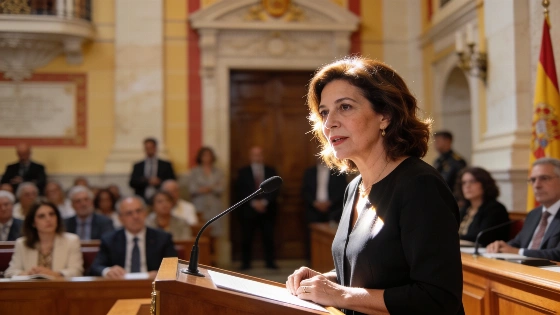
Maria Àngels Francés has taken charge of the Acadèmia Valenciana de la Llengua, defending a unified language identity. The institution faces a 25% budget cut and political pressure from Vox and PP.
The Acadèmia Valenciana de la Llengua (AVL) is under pressure after its new president, Maria Àngels Francés, took office in Valencia and immediately faced a 25% budget cut from the regional government. The reduction comes as Vox and Partido Popular step up criticism of the academy’s language policies. Vox representatives did not attend the inauguration.
Francés, a philologist and writer from Alcoy, used her first speech to defend the idea of a "unitary and unique" Valencian language. She described it as central to the region’s culture, stressing both its distinctiveness and its ties to the wider Catalan-speaking world. Francés made it clear the AVL would stick to its academic position on linguistic unity, despite political pressure for a more separatist approach.
Maria Àngels Francés officially assumed the presidency of the AVL on September 3, 2026, in a ceremony led by President Juanfran Pérez Llorca at the Palau de la Generalitat.
President Juanfran Pérez Llorca, representing the Generalitat and the Partido Popular, attended the ceremony with other senior officials. He voiced support for the AVL and the Valencian language, but also warned that the language should stay "flexible and close to the people," not "artificial." This comes after last year’s funding cut, which forced the AVL to rely on emergency support from the central government. According to Spanish media, the current cut was negotiated between PP and Vox, with Vox pushing for even deeper reductions and calling the academy’s spending unnecessary.
Vox’s absence was intentional. The party has targeted the AVL, accusing it of promoting language policies that clash with their view of Valencian identity. Still, the AVL’s legal status makes it difficult to dismantle. The tension was clear at the ceremony, with some education and culture officials missing, while university and social group representatives attended in support. Local news noted that Vox’s absence was seen as a deliberate signal in the ongoing dispute over the academy’s future.
Francés outlined three immediate goals: clearer and more practical language regulation for both native speakers and newcomers; encouraging the use of Valencian in daily life; and updating the AVL’s resources for younger generations, especially with new technology and artificial intelligence in mind. She said the academy’s work needs to be accessible and relevant, and promised to adapt communication to modern platforms. The overall Generalitat budget for 2026, which includes the AVL cuts, is 33.305 billion euros, a 3.1% increase from the previous year, according to official figures.
The budgetary dispute over the AVL is now part of the broader financial direction set for the remainder of the legislative period, after Les Corts definitively approved the 2026 budget on July 22. Vox has publicly stated it sees no point in negotiating new budgets before the 2027 elections.
Francés’s connection to the language is personal, shaped by her upbringing and years of academic work at the University of Alicante. Her leadership comes at a time when the AVL’s future is being questioned by politicians who see language as a tool in regional identity debates. Pérez Llorca called for "dialogue and consensus," echoing the AVL’s founding ideals, but the reality is a period of budget cuts and political confrontation.
The AVL is not alone in facing financial pressure. Across Spain, regional institutions have dealt with similar challenges as political parties use funding to influence cultural and language policy. The recent intervention by Spain’s chief prosecutor in the case of unaccompanied minors in Ceuta, as reported earlier, shows how regional and central authorities often clash over sensitive issues.
In Valencia, the conflict is direct: academic consensus on language meets political maneuvering. The AVL’s defense of linguistic unity is based on decades of research and international recognition, but it now has to justify its existence to politicians who see advantage in division. The budget cut is not just about money—it is a move to weaken the academy’s influence and shift the debate over Valencian identity. Unless the Generalitat changes course or new allies emerge, the AVL will have to operate with fewer resources and more scrutiny. The outcome will shape whether Valencian remains a living language in daily life or becomes further divided by politics.