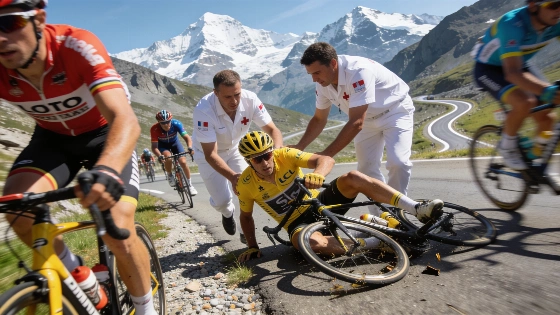
A crash at Plateau de Solaison ended Jonas Vingegaard’s Tour de France on Stage 15, just 20 kilometers from the finish. The Danish rider, a two-time champion who had never before left a Grand Tour because of injury, suffered a right collarbone fracture after losing control on a right-hand bend following a roundabout. Later coverage placed the crash near the roundabout with roughly 24 kilometers remaining. It ended his campaign and marked his first withdrawal from the Tour, where he had finished on the podium in each of his previous five appearances.
The crash came as the Visma team led the group of favorites in pursuit of the breakaway. Riding in fifth position, Vingegaard clipped the curb and fell heavily. His teammate Kuss, also involved in the crash, stayed with him until it became clear Vingegaard would not remount. Medical staff quickly attended to the Dane, who was taken away in an ambulance for further assessment. The injury was later described as a fracture of the right collarbone.
Stage 15, held on Sunday, 19 July, covered 183.9 kilometers from Champagnole to Plateau de Solaison. Vingegaard began the stage second overall, 4 minutes 30 seconds behind Tadej Pogačar. His withdrawal reshaped the standings with six stages left: Remco Evenepoel moved into second, five minutes behind Pogačar, who went on to win the Tour. Isaac Del Toro moved ahead of Paul Seixas in the under-25 classification, while Seixas remained fourth overall. Del Toro was also caught up in the crash but continued without major issues. The shift in the general classification sharpened the battle for the remaining podium places. See the detailed account of the previous day’s drama in this report on the Alsace mountain stage.
Earlier that day, Vingegaard revealed that he had undergone a surprise anti-doping control at 2:00 a.m. in his hotel, disrupting his rest for 40 minutes. He voiced frustration at the timing of the checks and their effect on recovery during a demanding race. Throughout the Tour, he had taken extra precautions, wearing a mask each morning to avoid illness, a routine that made his withdrawal after a crash all the more unusual.
Vingegaard’s 2026 season had been nearly flawless until the crash. He claimed overall victories at Paris-Nice and Volta a Catalunya, then won the Giro d’Italia and multiple stages across his campaign, completing his Grand Tour triple after taking La Vuelta in 2025. His Giro victory meant he arrived at the Tour after racing two Grand Tours in the same season. Visma | Lease a Bike manager Richard Plugge later said the crash prevented the team from assessing how that demanding schedule would affect Vingegaard in the Tour’s final week: “Obviously, he had a big, big crash unfortunately, so he could not show ultimately how it worked out in the last week.” Plugge also said the team had missed basic performance data from Stage 15 onward.
Vingegaard wore the yellow jersey after Visma’s team time trial win in Barcelona and held it through the second stage before relinquishing it to Pogačar. The rivalry between Pogačar and Vingegaard has defined the Tour’s top two spots since 2021; now it is on an unexpected pause. Vingegaard, who turns 30 in December, leaves behind Tour victories in 2022 and 2023, plus runner-up finishes in 2021, 2024 and 2025. Later coverage said the collarbone fracture ended his 2026 season and that he had not raced since the Tour.
The Tour de France remains one of the most prestigious and challenging events in world cycling, drawing global attention each July. Crashes and sudden withdrawals can reshape the race’s outcome and the careers of its top athletes. Vingegaard’s departure changed the current edition and marked a impressive moment in the ongoing rivalry at the top of men’s cycling. The final stages decided which riders seized the chance left by his absence and how the podium was settled in Paris.