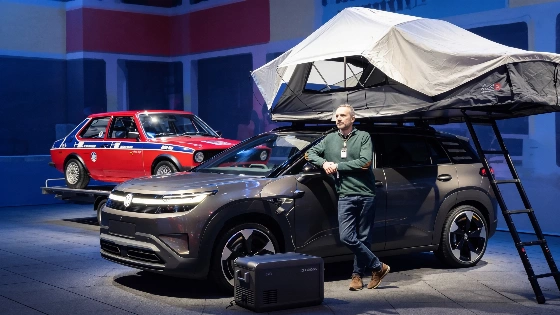
Volkswagen has opened orders in Spain for the ID. Cross, its new compact electric SUV, as the brand continues its shift to electric mobility. Inspired by the T-Cross and built on the MEB+ platform, the model comes with two battery chemistries and three power levels. A campaign price of €20,500 applies to the entry version when eligible commercial discounts are included.
The ID. Cross features the Pure Positive design language, developed by Andreas Mindt and his team. A light bar connects the headlights, while illuminated VW logos are available with IQ.Light matrix LED headlights. Wheel options range from 17 to 20 inches. Pronounced wheel arches and roof rails capable of supporting up to 75 kg add a subtle off-road character. Volkswagen has also made it possible to mount a rooftop tent, underscoring the model’s versatility.
The ID. Cross measures 4,153 mm long and 1,794 mm wide, and stands 1,581 mm tall, with a wheelbase of 2,601 mm. It is slightly longer than the T-Cross, with a wheelbase extended by 33 mm to improve rear passenger comfort. The rear boot holds 475 liters, 20 liters more than its petrol sibling. The front trunk, or frunk, adds another 22 liters. Its underfloor storage compartment is particularly spacious, thanks to the dedicated electric platform.
Inside, the ID. Cross borrows its dashboard layout from the Volkswagen ID. Polo, with upgraded materials and precise assembly. Physical buttons handle basic functions. The two-spoke steering wheel also uses traditional controls, with ergonomics and ease of use in mind. The digital instrument cluster and infotainment screen give the cabin a modern tech feel. The instrument display takes inspiration from the original Golf I, while the infotainment system shows a cassette tape animation when playing music.
Buyers can choose between a 37 kWh lithium-iron-phosphate (LFP) battery paired with an 85 kW (116 hp) or 99 kW (135 hp) motor, and a 52 kWh nickel-manganese-cobalt (NMC) battery paired with the 155 kW (211 hp) motor. Volkswagen Spain rates the smaller-battery versions at up to 324 km of WLTP range. DC charging peaks at 90 kW, with a claimed 10% to 80% charge time of about 23 minutes. Both 37 kWh versions have a stated top speed of 160 km/h. The 52 kWh variant is rated for up to 427 km under the WLTP cycle and can accept up to 105 kW of DC power, with a 10% to 80% charging time of about 24 minutes.
The 37 kWh version is aimed particularly at urban driving and daily commutes. Volkswagen’s Spanish subsidiary describes the smaller battery as especially suited to those uses. Spanish pricing reports list the entry-level Match at €28,885 before discounts, with an advertised campaign price of €20,500. The 99 kW versions are listed at €31,915 for Life and €35,775 for Style before promotions. Reported campaign prices are €23,180 and €26,770, respectively. These promotional figures combine commercial discounts and incentives, so they do not represent unrestricted list prices. One reported financing offer requires financing at least €15,000 over five years and keeping the vehicle for at least 36 months.
Volkswagen opened orders for the 37 kWh version in Spain in October 2026, following the earlier opening of orders for the 52 kWh model. The larger-battery range includes Life and Style trims, priced in the supplied model information at €36,930 and €40,780, respectively. Spanish reporting also identifies the 37 kWh model as manufactured in Navarra. Buyers can choose a lower-priced, urban-focused configuration or a more powerful version with greater WLTP range.
The ID. Cross’s arrival signals Volkswagen’s renewed commitment to making electric vehicles accessible to a wider audience in Spain. Its practical design and pricing put it in contention in the growing EV market. The recent debut of the Aston Martin Valhalla, a 1,079 hp hybrid supercar, offers a glimpse of the high end of the electric-era performance and luxury market. Read more about this shift in automotive technology in our coverage of Aston Martin’s new era of supercars.
As Spain’s electric-vehicle infrastructure continues to expand, models like the ID. Cross are likely to contribute to wider adoption. Volkswagen’s strategy of pairing familiar practicality with new technology could encourage more drivers to consider switching to electric mobility.