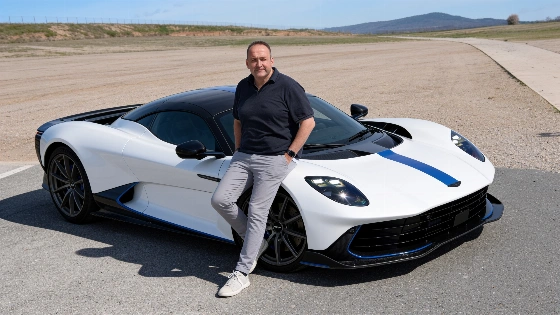
Aston Martin’s Valhalla arrives with a €1 million price tag and over 1,000 horsepower, blending Formula 1 technology with hybrid innovation. We explore what sets this radical machine apart from its Italian rivals—and why it matters for the future of high-performance cars.
When the Aston Martin Valhalla rolls to a stop, the air is thick with the scent of rubber and fuel. This is not just another supercar—it’s a statement. With a price tag of €1 million and a staggering 1,079 horsepower, the Valhalla is designed for those who crave the rawest driving experience modern engineering can offer.
Unlike the mythical paradise of its namesake, the Valhalla is very real—and fiercely exclusive. Aston Martin has built a machine that transforms any stretch of tarmac, whether a winding backroad or a racing circuit, into a playground for speed enthusiasts. The Valhalla is not about subtlety; it’s about delivering the kind of intensity that few cars can match.
Hybrid Power, AMG Precision
At the heart of the Valhalla lies a technical revolution for Aston Martin. For the first time in the brand’s history, the four-liter twin-turbo V8 from AMG sits behind the driver, not in front. Enhanced with larger turbochargers and aggressive camshafts, this engine alone produces 828 horsepower—almost 100 more than its German counterpart.
But the real leap comes from electrification. Three electric motors add another 251 horsepower, making the Valhalla Aston Martin’s first plug-in hybrid and pushing total output to 1,079 horsepower. The hybrid system is more than a nod to efficiency; it’s engineered for performance, with a 6.1 kWh AMG battery designed to withstand the brutal demands of track driving. While the car can travel up to 12 kilometers on electric power alone, its true advantage is the way electric torque sharpens handling and acceleration, especially through corners.
The Valhalla even features a charging port—a novelty for the brand. Yet practicality takes a back seat: there’s no space for a charging cable, and few owners are likely to plug in at home. This is a car built for the thrill, not for daily commutes.
Track DNA, Road Legal
In the world of hybrid hypercars, the Valhalla stands apart from rivals like the Lamborghini Revuelto and Ferrari Testarossa. While the Italians retain a road-focused character, the Valhalla feels closer to a Le Mans prototype, barely tamed for public roads. Its carbon fiber monocoque, dramatic vertical doors, retractable front wing inspired by Formula 1, and massive active rear spoiler all serve a single purpose: performance.
Inside, the cockpit is more fighter jet than grand tourer. The driving position is low and reclined, the controls focused and purposeful. Even a quiet rural road can feel like the Mulsanne Straight at Le Mans when you’re behind the wheel.
Driving Experience
The Valhalla’s true character emerges on the track. Here, its hybrid system and advanced aerodynamics work in concert, delivering relentless grip and explosive acceleration. The car clings to the asphalt, devouring corners and straightaways with a sense of urgency that borders on the surreal.
When the limits are tested, the electronics step in—not as strict overseers, but as partners. The front electric motors spin up to 19,000 rpm, helping the car carve through corners that would challenge even seasoned drivers. Rather than dulling the experience, the hybrid system amplifies it, making every lap more addictive than the last.
Focus shifts constantly between the digital display, the next braking point, and the pit wall. The urge for just one more lap is hard to resist.
Everyday Usability
Back on public roads, the Valhalla reveals a different side. Despite its extreme performance, it can settle into the role of a grand tourer, delivering surprising composure and comfort. The suspension adapts to changing surfaces, and even at speeds approaching 350 km/h, the car remains stable and unflustered.
Where other hypercars turn every drive into a spectacle, the Valhalla manages to blend drama with refinement. Its power is always present, but never overwhelming. This duality is what makes it so compelling: a machine that can dominate the track yet remain civilised on the road.
Context and Perspective
The Valhalla’s arrival signals a shift for Aston Martin, bringing the brand’s technology in line with the world’s most advanced performance cars. It’s a bold answer to the electrified future, joining a new generation of hybrids that includes not only Italian icons but also ambitious newcomers. For example, the recent launch of the Denza Z9GT in Spain, a Chinese luxury EV boasting 1,156 horsepower and ultra-fast charging, shows how the landscape is evolving and competition is intensifying. (See how new electric grand tourers are challenging the status quo.)
For Aston Martin, the Valhalla is more than a flagship—it’s a declaration that the brand is ready to compete at the highest level, blending tradition with innovation. While the shadow of James Bond looms large over the marque, the Valhalla stands on its own: precise, brutal, and unmistakably spectacular.
Key facts: The Valhalla is limited in production, with deliveries expected to begin soon. Its hybrid system is designed for both performance and emissions compliance, reflecting broader industry trends. As electrification reshapes the supercar market, models like the Valhalla set new benchmarks for what’s possible—on the road and beyond.