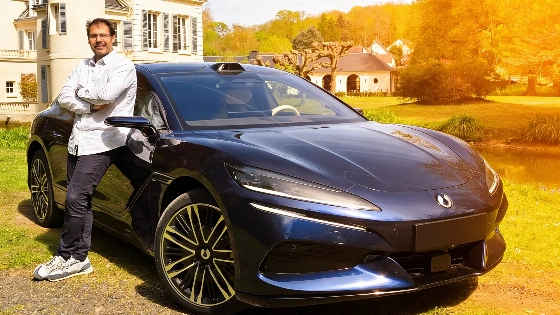
BYD has brought the Denza Z9GT to Spain, its most ambitious move yet into Europe’s luxury car segment. This grand tourer measures about 5.2 meters and was developed under designer Wolfgang Egger. It is built to compete with flagship sedans and estates from Germany’s top automakers. Its proportions follow the “golden ratio” for visual harmony, and it comes with electrified powertrains alongside advanced charging technology. The five-door shooting brake measures about 5,180 to 5,195 mm long and 1,990 mm wide. It stands 1,480 to 1,490 mm high, with a 3,125-mm wheelbase.
The Z9GT’s exterior has a clean, aerodynamic front, with features such as parking sensors and active air intakes smoothly integrated. Along the sides, the bodywork takes inspiration from the natural drape of silk, creating a continuous, flowing silhouette. At the rear, hourglass-shaped taillights and a suspended active spoiler work with the air suspension to improve aerodynamics and handling.
Inside, Denza’s focus on luxury is immediately apparent. BYD’s Cell to Body (CTB) battery integration makes a flat cabin floor possible and adds 15 mm of interior height. The cabin uses extensive leather, with smoked wood accents. Ambient lighting offers 128 customizable colors.
Front seats have 12-way electric adjustment, heating and ventilation, plus a 10-zone massage function. Linked to the air suspension, an active lateral support system adjusts automatically to hold occupants securely during cornering. The dashboard pairs a 17.3-inch floating central display with a 13.2-inch screen for the front passenger. Equipment also includes four-zone climate control and a panoramic glass roof spanning 2.1 square meters. A refrigerated compartment chills to -6°C, while a 20-speaker Devialet audio system completes the setup. Reported luggage capacity is 488 liters.
Powertrains and Performance
The Z9GT uses BYD’s e3 Platform, developed exclusively for Denza. The architecture supports a tri-motor all-electric setup and independent rear-wheel steering. It also includes advanced Vehicle Motion Control (VMC) and structural integration of the Blade Battery. The fully electric version delivers a combined 850 kW and 1,210 Nm of torque, from a 230 kW (313 HP) front motor and two 310 kW (421 HP) rear motors. Each rear motor can spin at up to 21,000 rpm. Spanish-market coverage puts combined output at 1,156 horsepower; other published specifications express the same 850 kW output as about 1,140 hp. The setup provides all-wheel lead and takes the Z9GT from 0 to 100 km/h in 2.7 seconds. Its reported top speed is 270 km/h.
The 122.49 kWh lithium-iron-phosphate Blade Battery delivers a WLTP range of up to 599 kilometers, commonly rounded to 600 kilometers. The Z9GT also brings BYD’s Flash Charging technology to Denza’s European lineup. BYD advertises rates of up to 1,500 kW across two charging points; depending on the installation, one connector can reportedly deliver up to 1,000 kW. The brand says a compatible vehicle can charge from 10% to 70% in five minutes, or from 10% to 97% in nine minutes. Those figures require dedicated Flash Charging infrastructure. They do not represent the output or charging times available from ordinary public chargers.
The system’s peak rating reflects the station setup, not a continuous output guaranteed at every site. Denza Belux representative Pierre Voineau told FLEET.be: “We work with a stationary battery of 400 kWh. We only need 100 kW from the electricity grid to charge that battery.” The battery buffer lets the station draw power from the grid at a lower rate, then deliver much higher peak power to a compatible vehicle.
The plug-in hybrid, designed for greater versatility, uses BYD’s Super DM technology. It pairs a 2.0-liter turbocharged petrol engine with a 200 kW (272 HP) front electric motor and two 185 kW (252 HP) rear motors. The system delivers 775 HP and 1,035 Nm, accelerating from 0 to 100 km/h in 3.6 seconds. This version has a 63.82 kWh Blade Battery, giving it 203 kilometers of electric-only range (WLTP). With the battery and fuel tank combined, its range is 805 kilometers.
Pricing and Market Position
The Denza Z9GT is now available in Spain. The plug-in hybrid starts at €101,000, while the all-electric model costs €115,000. European coverage has also reported reservations in seven markets, including Spain and France, as well as Germany and Italy. The prices put the Z9GT up against established European luxury brands, with performance and charging technology among its selling points. BYD’s premium sub-brand is targeting the luxury grand-tourer and shooting-brake segment. Its large body, tri-motor all-wheel lead and long-range battery distinguish it from mainstream electric cars.
For Spanish drivers weighing the value of premium fuels and new technologies, the Z9GT’s arrival adds another dimension to a changing ownership field, where fuel choices and vehicle technology are reshaping costs. For more on how premium fuel decisions affect Spanish motorists, see this analysis on the real value of premium gasoline at Spanish stations.
Context and Outlook
BYD’s European expansion with the Denza Z9GT reflects a broader trend: Chinese automakers are targeting the continent’s premium segments. The Z9GT pairs power and luxury with charging technology in the electric grand-tourer category. It is positioned as a technology and performance challenger to high-end models such as the Porsche Panamera and Porsche Taycan. Its advertised acceleration and charging performance are basic to that pitch, but the practical experience of ultra-fast charging will depend on the rollout of compatible dedicated stations across Spain and Europe. As that infrastructure grows, vehicles like the Z9GT could change expectations for long-distance electric travel. BYD is betting that performance and technology can win over buyers traditionally loyal to established European brands.