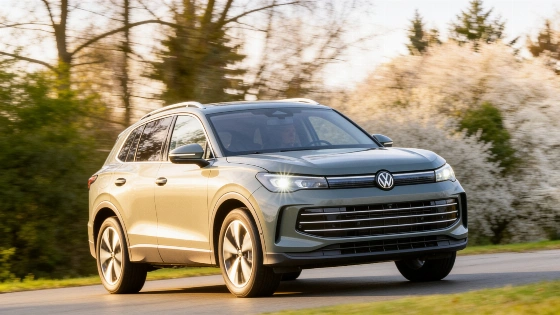
With a starting price just over €60,000, the Volkswagen Tiguan 2.0 TDI 4Motion is positioned as a premium SUV for buyers who want power alongside practicality. The tested model, fitted with basic extras, brings the total closer to €61,700. Buyers get a spacious interior and a refined ride, along with a diesel engine designed to reduce fuel stops on long journeys. The Tiguan range includes petrol, diesel, mild-hybrid and plug-in-hybrid powertrains. Equipment, drivetrain and performance vary by version and market.
Under the hood, the tested Tiguan’s 2.0 TDI engine delivers 200 hp and 400 Nm of torque, paired with Volkswagen’s 4MOTION all-wheel lead. It weighs 1,781 kg, accelerates from 0 to 100 km/h in 7.8 seconds and reaches a top speed of 226 km/h. The European diesel range also includes a 150 PS front-wheel-lead version and a 193 PS 4MOTION model with a seven-speed DSG, information from the Europe-Mobile model overview. These versions show how output varies across Tiguan specifications; the test figures describe this particular configuration. Its acceleration and torque make overtaking and motorway merging feel confident. Comparisons with electric SUVs depend on which models and measures are being considered.
Fuel efficiency remains a strong point. Even when pushed hard on unrestricted German motorways, the Tiguan’s consumption stayed at 9.1 l/100 km. In more typical mixed driving, the average dropped to 6.7 l/100 km. Careful driving could bring it as low as 5.4 l/100 km. These are road-test observations. Published consumption and emissions figures for the Tiguan are calculated under the Worldwide Harmonized Light Vehicles Test Procedure (WLTP), a standardized laboratory cycle that replaced the former NEDC procedure from 1 September 2018. Actual fuel use varies with speed, traffic, temperature, tyres, load and driving style, so road-test figures differ from certified WLTP values.
Engine and Driving Experience
The diesel engine is generally quiet, becoming noticeable only under heavy acceleration. Volkswagen’s sound insulation helps keep the cabin calm, while the seven-speed dual-clutch automatic transmission shifts smoothly and sends power efficiently to all four wheels. Paddle shifters behind the steering wheel allow manual gear changes, though their small size may not suit every driver.
Chassis and Handling
The Tiguan’s adaptive DCC Pro suspension offers a broad range of settings, from sporty to comfort-oriented. It keeps the body well controlled over rough surfaces and limits unwanted movement. The precise steering inspires confidence through curves and gives the driver a reassuring sense of control. Braking performance is equally strong: measured stopping distances were 35.7 meters cold and 33.6 meters warm, with no sign of fading after repeated hard stops.
Interior Quality and Features
Inside, the Tiguan reflects Volkswagen’s reputation for solid build quality and pleasant materials. Some minor dashboard creaks over cobblestones, but, suggest that a few trim pieces are not perfectly fitted. The central touchscreen’s menu structure may divide opinion, but its upper quick-access bar covers impressive functions. The voice control system is notably effective. An optional 15-inch display adds a premium touch, with navigation and entertainment features integrated.
The front ergoActive seats are a highlight, with electric adjustment, memory, extendable thigh support and massage programs lasting up to 30 minutes. Both driver and passenger get heating and ventilation, while well-shaped side bolsters provide excellent lateral support, even during spirited driving.
Space and Practicality
Rear passengers get generous head and legroom, making the Tiguan suitable for tall occupants on long trips. Independent climate controls and heated outer seats add comfort, while two USB-C ports provide charging access. Luggage capacity is strong: the test specification gives 650 liters with the rear seats up, expanding to 1,650 liters when folded. Europe-Mobile lists 652 liters for the luggage compartment and a maximum braked towing capacity of 2,300 kg. An optional tow hitch broadens the Tiguan’s family and leisure appeal, including for buyers towing a large trailer.
How It Compares
In the competitive SUV segment, the Tiguan 2.0 TDI 4MOTION combines diesel efficiency with real-world performance and comfort. Its price is higher than many rivals, so it is aimed at buyers who prioritize long-distance capability and premium features. Comparing it fairly with hybrid or electric SUVs means choosing specific criteria, such as acceleration, motorway range, refuelling or charging time and running costs. Buyers weighing alternatives will also find contenders in the hybrid and luxury SUV segments, including the Volvo XC40 and Alfa Romeo Tonale, recently compared in detail in this analysis of leading hybrid SUVs.
Final Thoughts
The Volkswagen Tiguan 2.0 TDI 4MOTION costs well above budget territory, but offers a compelling package for drivers who need space, comfort and efficiency on long journeys. Its diesel engine remains relevant to buyers who value range and torque. Overall, the execution matches Volkswagen’s reputation for quality. The Tiguan focuses on everyday usability and long-distance comfort, making it a strong option for buyers seeking those qualities.
Diesel SUVs retain a niche in Europe, particularly among drivers covering high annual mileages. Electrification is reshaping the market, yet models such as the Tiguan 2.0 TDI 4MOTION still appeal to buyers who value long-distance capability and towing capacity, along with the convenience of rapid refuelling.