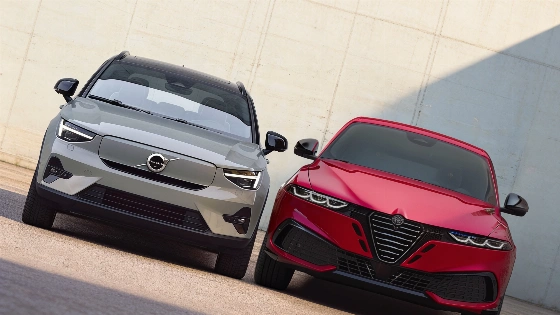
The Volvo XC40 and Alfa Romeo Tonale stand out among hybrid SUVs under €40,000 in Spain. We break down their engines, space, features, and pricing to help you decide which model fits your needs in 2026.
Choosing between the Volvo XC40 and Alfa Romeo Tonale in 2026 means weighing two of the most compelling hybrid SUVs available for under €40,000 in Spain. Both models promise a blend of efficiency, technology, and practicality, but their strengths diverge in key areas that matter for buyers looking ahead.
Dimensions and Space
The Volvo XC40, a mainstay in the Swedish brand’s lineup, measures 4,425 mm in length, 1,865 mm in width, and 1,650 mm in height, with a wheelbase of 2,700 mm. This compact SUV offers a premium feel and a slightly taller, wider stance compared to its Italian rival. The Alfa Romeo Tonale, refreshed at the end of last year, stretches to 4,520 mm long, 1,840 mm wide, and 1,600 mm high, riding on a 2,635 mm wheelbase. The Tonale is longer, but the XC40 is both wider and taller, which can influence cabin comfort and road presence.
Cargo Capacity
For families or those needing extra space, the boot is a decisive factor. The Volvo XC40 provides 450 liters of luggage space in its hybrid versions (485 liters for the electric), expanding to 1,330 liters with the rear seats folded. The Alfa Romeo Tonale offers up to 500 liters in its standard hybrid, but the plug-in hybrid (PHEV) version drops to 385 liters due to battery placement. With seats down, the Tonale’s cargo area reaches 1,550 liters (1,430 liters for the PHEV), giving it a clear edge in maximum capacity, especially for the non-PHEV variant.
Engines and Performance
The Volvo XC40 lineup includes mild hybrid (MHEV) petrol engines and full electric options. The MHEV range features two 2.0-liter petrol engines producing 163 hp and 197 hp, both with automatic transmission, front-wheel drive, and Spain’s ECO environmental label. The electric XC40s offer 238 hp (69 kWh battery, 480 km range), 252 hp (82 kWh, 575 km), and a dual-motor 408 hp AWD version (82 kWh, 538 km range).
The Alfa Romeo Tonale brings more variety, with a 1.6-liter 130 hp diesel, a 1.5-liter 175 hp mild hybrid petrol (ECO label), and a standout 270 hp plug-in hybrid (PHEV) with a 15.5 kWh battery, AWD, and up to 61 km of electric range (Zero Emissions label). All Tonale engines are paired with automatic gearboxes. The PHEV’s electric-only range and all-wheel drive set it apart for those prioritizing low-emission urban driving or occasional off-road capability.
Standard Equipment
Volvo’s XC40 Essential trim includes comfort front seats, cruise control, LED headlights, a 9-inch central touchscreen, 12-inch digital instrument cluster, rain and light sensors, rear parking sensors, lane keeping assist, and traffic sign recognition. Safety and driver assistance remain Volvo’s hallmark.
The Alfa Romeo Tonale, even in its entry trim, comes well-equipped: 17-inch alloy wheels, autonomous emergency braking, electric mirrors, rain and light sensors, leather sports steering wheel, drive modes, keyless entry and start, dual-zone climate control, rear camera, auto-dimming interior mirror, adaptive cruise control, fatigue detector, traffic sign recognition, lane keep assist, LED headlights, parking sensors, digital instrument cluster, multimedia touchscreen, and smartphone integration (Android Auto and Apple CarPlay). The Tonale leans into technology and convenience, offering a richer standard package for tech-focused buyers.
Pricing
In Spain, the Volvo XC40 is currently available only from stock, with the 163 hp mild hybrid starting at €42,800. However, a direct dealer discount of €6,500 brings the price down to €36,300. The Alfa Romeo Tonale’s 170 hp mild hybrid version is listed at €37,700, while the PHEV starts at €47,020. This positions the XC40 as slightly more affordable than the Tonale hybrid, though the PHEV commands a significant premium for its extra power and electric range.
Key Differences
Comparing the two, the Alfa Romeo Tonale is longer and offers more boot space in its standard hybrid form, while the Volvo XC40 is wider, taller, and has a longer wheelbase, which may benefit interior comfort. The Tonale’s PHEV version stands out for its electric-only driving and all-wheel drive, but at a higher price point. Volvo’s XC40, meanwhile, focuses on mild hybrid efficiency and a reputation for safety, with competitive pricing thanks to current discounts.
When it comes to standard features, the Tonale edges ahead in technology and convenience, but the XC40 maintains its lead in safety and driver assistance. For buyers prioritizing electric range and AWD, the Tonale PHEV is the clear choice, while those seeking value and a premium feel may lean toward the XC40.
Context and Market Trends
Hybrid SUVs continue to gain traction in Spain, with buyers increasingly weighing electrification levels, environmental labels, and real-world practicality. The competition is fierce, as seen with models like the Mercedes GLC 400 EQ 4Matic, which has set new standards for comfort and range in the segment—details explored in our recent look at how Mercedes is redefining electric SUV travel. As incentives and regulations evolve, the balance between price, technology, and efficiency will remain central to the SUV market in Spain.
In summary, the Volvo XC40 and Alfa Romeo Tonale each offer distinct advantages. The right choice depends on whether you value electric range, AWD, and tech features (Tonale PHEV), or prioritize safety, premium build, and a sharper price (XC40). Both models reflect the rapid evolution of the hybrid SUV landscape in Spain as 2026 approaches.