Andalusia Leads in Poverty and Income Gap Despite Economic Growth. Andalusian authorities report record economic and employment growth. However, the region still ranks last in income and poverty levels. Key figures contradict official optimism.
Andalusia continues to experience economic growth and job creation, yet the region remains at the bottom in Spain in terms of income and leads in poverty rates. Despite statements by the head of the autonomous community, Juan Manuel Moreno, about turning Andalusia into the country's "locomotive," key social and economic indicators point to deep inequality and structural problems.
Data versus optimism
According to recent data, GDP and employment growth rates in Andalusia are indeed higher than the national average. However, in terms of GDP per capita, the region lags behind the national figure by more than €8,000—€24,542 compared to €32,800 in Spain. Meanwhile, the poverty or social exclusion risk rate (Arope) in Andalusia stands at 34.7%, significantly above the national average (25.8%).
Experts note that official statistics do not reflect the real situation for most residents. According to economists, improvements in certain macroeconomic indicators are linked to nationwide trends, not to solving the region's structural issues. Traditionally, Andalusia creates jobs more quickly during periods of growth, but also loses them faster during crises due to its unstable economic structure.
Structural problems
The main sectors of the region—agriculture and tourism—generate profits for large companies but do not provide sustainable income growth for the local population. In the agricultural sector, most of the added value is captured by distributors, and in tourism—by national and international hotel chains, while expenses related to rising housing and service costs fall on the residents of Andalusia.
Even with the unemployment rate reduced to 14.66% (according to the latest EPA data), the region still lags behind the national average. Moreover, having a job does not guarantee an escape from poverty: many families are forced to work two jobs to meet housing costs and basic needs. According to organizations involved in social support, the average rent in 2025 increased by 11.8%—three times faster than wages.
Small business and investments
The authorities of Andalusia emphasize the growth in the number of entrepreneurs and companies, yet 85% of the 570,000 registered self-employed individuals work without hired employees, indicating a high level of instability. Of the 644,749 companies registered in the region, nine out of ten are micro-enterprises, and Andalusia leads in the absolute number of company closures.
Experts believe that a focus on attracting outside investment and large companies does not lead to long-term development unless businesses are integrated into the region’s economy. Sustainable growth requires support for local enterprises and creating conditions for capital retention within Andalusia.
Social reality
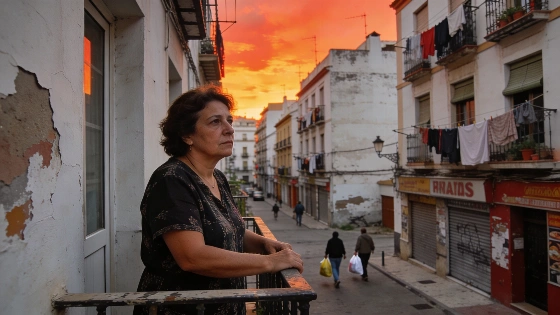
Many residents, despite official reports of growth, do not feel an improvement in quality of life. In the poorest neighborhoods, such as Los Pajaritos in Seville, people survive on minimal benefits and face rising costs for housing, food, and utilities. According to INE, 10 out of the 15 poorest districts in Spain are located in Andalusia.
Even with a decrease in the share of the population at risk of poverty, the region remains among the most vulnerable. Representatives of social organizations note that rising prices for housing and food threaten even the middle class.
The impact of migration and the shadow economy
Economists point to additional factors hindering income growth: a high level of the shadow economy (17.9% of GDP—one of the highest in the country) and an outflow of young professionals to other regions. At the same time, a significant portion of new jobs is linked to low-skilled labor, which is often filled by migrants.
Issues of inequality and poverty in Spain have been raised before. For example, in a piece about new tax benefits for low-income workers, support measures for low-income families were considered, however in Andalusia these initiatives have not yet led to a noticeable reduction in the gap with the rest of the country.