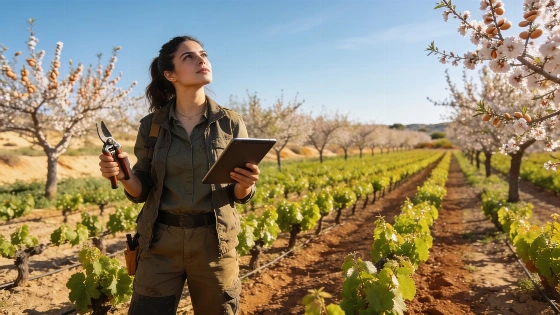
Paula Nuévalos, known online as @agropauli, is an unconventional face of Spanish agriculture. At 27, with a degree in mechanical engineering, she manages her family’s organic vineyard and almond fields in the Utiel-Requena region of Valencia. She returned to farming after her father’s death, choosing to carry on a family enterprise: her grandfather founded the winery, and her father continued its work. For Nuévalos, the greatest reward of working as a self-employed farmer is not a monthly paycheck but the freedom to shape her own days and future.
In a recent video, Nuévalos set aside the usual talk of hardship in the sector to explain what keeps her committed to the land. She points to the room for growth that comes with running your own business. “There is no ceiling to what you can earn,” she says, while acknowledging that losses have no ceiling either. The risks are real, and so are the opportunities. In an interview reported by Marca, she described the calm she finds in the work: “As soon as I start pruning, I feel peace of mind.”
Freedom and Ability to recover
Nuévalos says self-employment has forced her to become resilient. Farming’s daily demands, from the weather and market prices to uncertainty at each harvest, call for “steel health,” as she puts it. Although she grew up accompanying her father in the fields, managing the operation meant learning practical tasks such as ploughing and applying vineyard treatments, along with making production decisions. Over time, she has learned to handle frustration and build skills well beyond her engineering background.
Above all, she values the autonomy to organize her own schedule. Being in charge of her time lets her balance farm work with her personal life, including ongoing education, without being tied to someone else’s timetable. That flexibility does not mean working less: agricultural cycles, weather and crop needs often require long hours. The difference is having the power to decide how and when to invest that effort. Nuévalos has also distinguished rural life from a rural holiday, telling ABC: “People from the city say they love the village. No, what you like is being on holiday in a peaceful place.”
Uncertain Incomes
Official salary references for agricultural workers in Spain hover around €1,400 to €1,500 gross per month. But, as Nuévalos explains, these figures do not reflect life as a self-employed farmer. Income can swing dramatically from one season to the next, depending on harvest yields and market prices, as well as farm size. Costs add to the uncertainty: fuel and fertilizers, along with machinery, insurance and irrigation, all affect the bottom line. Subsidies from the Common Agricultural Policy help, but Nuévalos insists that genuine sustainability depends on prices covering actual production costs.
Her family’s crops had been converted to organic production around 10 to 15 years before she took over, giving the farm an established organic foundation. Nuévalos’s next step is to improve wine quality and sell more directly to consumers instead of relying solely on the price paid for grapes. This could allow a producer to retain more value in the finished product, while taking on added responsibility for processing and sales.
The broader sector figures show why national growth does not automatically give an individual farmer a predictable livelihood. CaixaBank Research figures reported by Levante-EMV show agricultural output rising 15% in 2024 and 11.9% in 2025, followed by a further 5.6% year-on-year increase in the first half of 2026. Agricultural Social Security affiliations rose 1.6% from January to August compared with the same period in 2025. The same assessment put agricultural income growth at 8.9% in 2025, as production rose 7.5% against a 4.8% increase in costs.
Spain’s agricultural income reached €39,798.57 million in 2025, information from Eurostat figures cited in a report carried by Infobae’s news-agency service. That is an aggregate sector measure, not an individual farmer’s salary or disposable income: farm receipts must cover operating costs before personal earnings are determined. Taxation and social security contributions for self-employed farmers are also complex. From 2026, contributions are based on income brackets, and some farmers can opt for a special VAT regime, each with its own requirements. The financial field is as variable as the weather.
Few Young People in the Fields
Spain’s Ministry of Agriculture reports that only 19.8% of self-employed agricultural workers are under 40. Among salaried employees in the sector, the share of young people is higher, at 40.1%. Many farmers keep working past retirement age: 7.8% of self-employed agricultural workers are over 65, compared with just 1.2% of employees.
Nuévalos’s story is a rare example of a young person choosing to stay in agriculture. For most, the barriers are high: uncertain profits and large investment, alongside the difficulty of securing a stable income. The rewards are real, as are the risks. Spanish farming’s future may depend on whether more young people are willing to take that gamble.
As Talent24h reported, the debate over making agriculture more attractive and viable for the next generation remains unresolved. For now, stories like Nuévalos’s show what can happen when autonomy and ability to recover outweigh the comfort of a fixed salary.