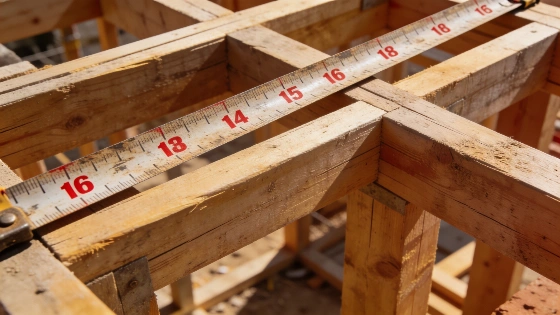
If you've ever noticed red numbers appearing at regular intervals on your tape measure, there's a practical reason. These marks, set every 16 inches, are designed to simplify construction tasks—especially when working with wooden frames—by eliminating the need for constant recalculation.
Red numbers printed at precise 16-inch intervals on many tape measures are not a manufacturing quirk or a warning sign. Instead, they serve a clear purpose for anyone working with wood framing, especially in construction environments where speed and accuracy matter. This marking system, confirmed by manufacturers like Komelon and Stanley, is designed to streamline the process of laying out wall studs and other structural elements without the need for repeated calculations.
Each red number corresponds to 16 inches, or exactly 40.64 centimeters. In the imperial measurement system, this is the standard spacing between the centers of wall studs in light-frame construction. By highlighting these intervals, tape measures allow builders to quickly identify where each stud should be placed, ensuring consistent spacing and structural integrity. The red marks appear at 16, 32, 48, 64, 80, and 96 inches, making it easy to plan out an entire wall section at a glance.
Visual Shortcuts in Construction
The use of red numbers is a visual shortcut, helping users avoid the need to add up multiples of 16 inches manually. This is particularly useful when working with large panels or sheets, as it aligns with standard building materials and construction practices. While some tape measures also feature black diamond marks at 19.2-inch intervals for alternative framing layouts, the red 16-inch marks remain the most widely used reference in North American and some international construction.
It's important not to confuse these red numbers with centimeters. One inch equals 2.54 centimeters, so 16 inches is always 40.64 centimeters. The way these intervals are marked can vary: some manufacturers print the entire number in red, others use boxes or arrows, and some keep all numbers the same color but add a different symbol. Always check the tape's scale and specifications to understand what each marking means.
Stud Spacing and Wall Layout
The 16-inch spacing refers to the distance from the center of one stud to the center of the next. This regular pattern is essential for distributing weight evenly and for attaching wall panels or drywall efficiently. For example, a standard 8-foot (96-inch) wall section will fit six full 16-inch modules, making the layout process straightforward. Stanley and other brands highlight these intervals specifically for framing work, making their tape measures a practical tool for professionals and DIYers alike.
However, these red marks are only a guide for new construction or when working from a known reference point. They do not indicate the actual location of studs behind finished walls, nor do they guarantee that every wall follows this pattern. Before drilling or mounting anything on an existing wall, it's essential to use a stud finder or another reliable method to locate the structure beneath the surface.
Why This Feature Is Less Noticed in Spain
In Spain, the metric system is standard, and most measurements are given in meters, centimeters, or millimeters. As a result, the 16-inch reference is less intuitive for those who have never worked with Anglo-Saxon framing traditions. For many Spanish users, the red marks may seem decorative or irrelevant, even though they have a specific function in markets where imperial measurements dominate.
Some tape measures sold in Spain and across Europe feature dual scales, showing both centimeters and inches. Imported tools or models designed for multiple markets may include these red marks, along with other features like a small gap before the zero mark or black diamond symbols. None of these replace the need to read the main scale carefully, and they do not automatically convert imperial to metric measurements.
Precision Features: The Movable Hook
Another detail often misunderstood is the small movement allowed in the tape measure's metal hook. This is not a defect. As Stanley explains, the hook is designed to compensate for its own thickness, ensuring accurate measurements whether you are hooking onto the outside of a board or pressing against an inside surface. The amount of play should match the thickness of the hook itself, not result from a loose or damaged rivet.
Some tape measures also indicate the length of their casing, allowing users to measure interior spaces without bending the tape. By placing the body of the tape measure against one wall and extending the tape to the opposite side, you can add the casing length for an accurate total. This feature should only be used if the manufacturer clearly marks the casing's length.
While these details may go unnoticed by casual users, they reflect the practical thinking behind everyday tools. For those working in construction or DIY, understanding the logic of these markings can save time and prevent costly mistakes.