Uruguay Prepares New Tactics for 2026 World Cup: Focus on Pressing and Speed. The Uruguayan national team heads to the 2026 World Cup with an updated game plan under Marcelo Bielsa. The squad is focusing on high-intensity pressing and rapid attacks. The main question — can Darwin Núñez take over from the legendary forwards in attack?
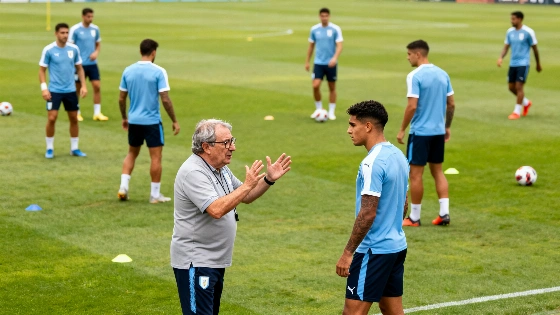
The Uruguay national team approaches the 2026 World Cup with a noticeably changed playing style. New head coach Marcelo Bielsa, for whom this is the third World Cup with different national teams, is implementing an aggressive vertical style and demands maximum intensity from his players in every area of the pitch. This approach has already yielded results during the qualifiers: Uruguay became CONMEBOL's leader in high ball recoveries, confirming the effectiveness of Bielsa's pressing system.
However, the squad overhaul has come with losses. For the first time in many years, Luis Suárez and Edinson Cavani—players who defined the national team at major tournaments—will not feature in attack. Now all responsibility for results rests with Darwin Núñez, who, after his move from Liverpool to Al-Nassr, remains the only forward with top-level experience. In qualifying, he was the team’s top scorer, but the pressure on him is increasing: replacing two legends at once is no easy task.
Bielsa’s tactical setup is built on flexibility: he uses both 3-3-1-3 and 4-1-4-1 formations, emphasizing width and speed in transitions from defense to attack. In attack, players constantly move into open spaces, and in defense, there is man-to-man pressing across the pitch. This style demands not only physical fitness, but also high concentration—Bielsa has faced situations in the past where his teams have run out of steam by the decisive matches of a tournament.
The team's main weakness remains the lack of attacking depth: if Núñez cannot handle the workload or is sidelined by injury, there is no replacement for him. In addition, Uruguay has not advanced beyond the quarterfinals since 2010, and now the team must prove that its updated philosophy can deliver results at the highest level. In this context, the experience of other national teams is also of interest, where transitions of generations and coaching methods become key factors: for example, in the match between Brazil under Ancelotti's guidance, the question of who will lead the attack at the start of the tournament is also being debated.
For reference: Marcelo Bielsa is one of the few coaches who has taken three different national teams to the World Cup. His teams are known for their high tempo and unconventional tactical decisions. In the 2026 World Cup qualifiers, Uruguay made 147 high recoveries—26 more than the next closest team. Darwin Núñez scored 5 goals and provided 2 assists, remaining a key figure in attack. The absence of Suárez and Cavani could be both a weakness and an opportunity for the new generation of players to prove themselves on the world stage.