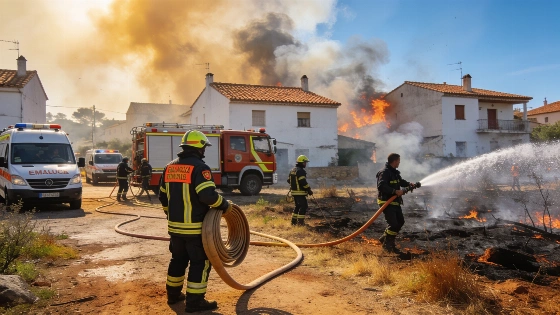
A fast-moving wildfire near Tordera led to urgent evacuations and a lockdown for two residential areas, underscoring the high fire risk in Catalonia during the ongoing heatwave.
Residents in Can Camps and Roca-Rossa, two neighborhoods in Tordera, were woken by emergency orders to evacuate or stay indoors after a wildfire broke out close to their homes. Local police went door to door, and Catalonia’s Civil Protection sent an Es-Alert message instructing entire neighborhoods to seal themselves inside. Flames had already reached the edge of residential streets, putting people and property in immediate danger.
The fire started after 10:00 a.m., when emergency services received a call about a bus on fire. The flames quickly spread into the forest near Camí Ral del Monestir. Hot, dry weather made the situation worse, pushing the fire toward homes. Firefighters responded with eleven ground units and two aircraft, focusing on keeping the fire from reaching more houses. Spain's Civil Protection Service noted that the first days of September 2026 brought persistent high temperatures, raising wildfire risk across Catalonia.
On August 29, 2026, Catalonia reported a 'very high' wildfire risk in 58 municipalities, activating level 3 of the Alfa plan.
By 11:12, Civil Protection had activated its mass alert system, telling residents of Can Camps and Roca-Rossa to stay inside and seal their homes. The urgency reflected the region’s vulnerability: that Saturday, Catalonia faced a level 4 "extreme" fire risk in 34 municipalities across 10 comarcas, and another 356 municipalities were at level 3 "very high" risk, according to the Agentes Rurales. Authorities had already warned that the extreme heat and dry thunderstorms would last until at least September 4 or 5, increasing the risk of more fires.
Police prioritized evacuating the most exposed houses before the fire could cross into residential areas. What began as a single vehicle fire quickly turned into a forest blaze, showing how fast conditions can worsen during a heatwave. Aerial support was essential, as ground crews struggled with steep terrain and high temperatures. Protecció Civil of Catalonia later stressed that mass ES-Alert notifications should be used only for clear instructions during real emergencies, not as a general warning tool.
For residents, the sudden lockdown and evacuation meant dropping daily routines and worrying about their homes. The Tordera fire is a clear example of how climate-driven fire risk is now a practical reality in Catalonia. With hundreds of municipalities now listed as high or extreme danger zones, emergency protocols are being put to the test. The speed and scale of the response in Tordera show that local authorities are acting quickly to protect people and property. As the summer heat continues, the real measure of these efforts will be how many communities avoid disaster when the next fire starts.
In neighboring Aragon, authorities introduced a red level of wildfire danger in 12 zones on August 30, 2026, reflecting the widespread phase of extreme fire threat across the Pyrenean Peninsula during this period.