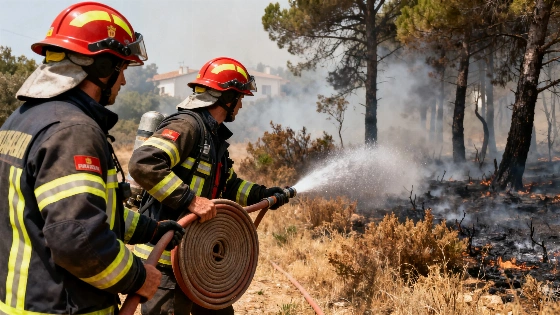
A major wildfire in Les Gavarres has reached homes in Calonge, Girona. Firefighters are racing to stabilize the perimeter as strong winds and high temperatures complicate efforts. Thousands remain confined in affected towns.
A fast-moving wildfire that erupted in La Bisbal d’Empordà, Girona, has now reached residential areas in Calonge, burning one house and damaging gardens and fences of a dozen more in the Cabanyes urbanization. The fire, which broke out on Friday, continues to threaten the protected natural area of Les Gavarres and has forced authorities to confine seven municipalities, impacting around 10,000 residents.
Firefighters, supported by the Unidad Militar de Emergencias (UME), have deployed 400 personnel to the scene. Overnight, teams worked under challenging conditions as shifting winds—first Tramuntana, then Marinada—drove the flames closer to populated zones. According to the latest official figures, the fire has affected a perimeter of 2,400 hectares, with the potential to expand to as much as 30,000 hectares if not contained.
David Borrell, head of the firefighting operation, reported early Saturday that 70% of the fire’s right flank has been stabilized, but critical work remains near Puig d’Arques. The main priority is to secure the perimeter before southerly winds expected later in the day risk further spread. In Calonge, about 120 people spent the night in a sports hall after evacuations, while authorities continue to urge residents to remain indoors and avoid self-evacuation due to safety concerns.
The fire’s impact extends beyond Calonge, with lockdowns in La Bisbal, Calonge i Sant Antoni, Castell d’Aro, Platja d’Aro i s’Agaró, Forallac, Llagostera, and Santa Cristina d’Aro. Emergency services also had to confine 150 children at the El Pou del Glaç camp, with some already evacuated and others scheduled to leave as conditions allow.
Police detained a worker suspected of starting the fire while using a metal-cutting saw on a road in La Bisbal, a tool banned under the current level 3 fire prevention plan due to the risk of sparks. The incident highlights the ongoing challenges of fire prevention during periods of extreme heat and wind, which are common in the region and complicate firefighting efforts.
As the situation develops, local authorities and emergency teams remain focused on protecting both densely populated and forested areas. The risk of further escalation remains high, especially with a second heatwave forecasted for the region. For additional background on the emergency measures and the scale of the threat, see this detailed report on the lockdowns and firefighting response in the area: how the Les Gavarres wildfire forced lockdowns across seven Catalan towns.
Wildfires are a recurring threat in Catalonia, particularly during the summer months when high temperatures and dry conditions prevail. The Les Gavarres area, known for its dense forests and proximity to tourist destinations on the Costa Brava, is especially vulnerable. Spanish authorities have reinforced fire prevention measures in recent years, but illegal or negligent use of equipment remains a significant risk factor. The current incident underscores the importance of strict adherence to fire safety regulations, especially during periods of elevated danger. As the firefighting operation continues, residents are advised to follow official instructions and remain alert to updates from local authorities.