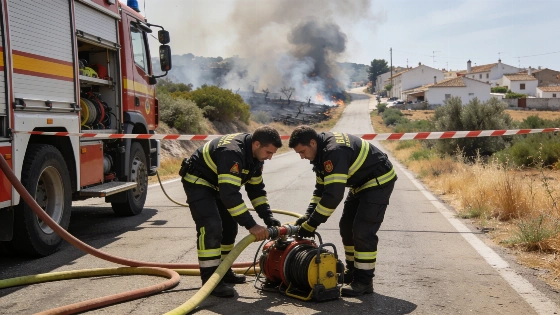
Authorities in Huelva declared an emergency after a wildfire broke out near Niebla on Thursday evening, 6 August 2026, prompting the evacuation of Raboconejo and Caballón. The fire started close to kilometer 13 of the HU-3106 road and spread rapidly, prompting officials to raise the alert to operational phase 1. As a precaution, authorities closed the road between La Florida and Niebla to all traffic.
Antonio Sanz, regional minister for the Presidency, Interior, Social Dialogue and Administrative Simplification, urged residents to stay cautious and follow emergency services' instructions. In a message posted on the official X account, Sanz advised locals to keep doors and windows shut to prevent smoke entering homes, stay away from the affected area and cooperate fully with emergency teams.
Cecem 112 received the first emergency call at 18:34. Reports soon came in from across the province, including Valverde, Beas, Zalamea and La Granada de Riotinto. Residents said the fire was advancing dangerously close to residential areas. The response brought in the Provincial Operations Center of Huelva (COP) of EMA Infoca, provincial firefighters, the Guardia Civil and its Traffic Division, the National Police unit assigned to the region, the 061 Emergency Health Service and road maintenance teams.
Firefighting efforts involved 60 personnel on the ground, backed by two fire engines, two heavy helicopters and one medium helicopter. The aerial response also included four ground-based water bombers, two light amphibious planes and one heavy amphibious aircraft from Spain's Ministry for the Ecological Transition and the Demographic Challenge. Crews also deployed three bulldozers and the Forest Fire Medical Unit (UMIF). The scale of the response reflected the immediate threat to nearby communities and the need to coordinate ground and aerial operations.
The emergency later grew well beyond the initial evacuations. A subsequent assessment said the fire, which started on 6 August, had covered approximately 38,000 hectares over nine days. Authorities said it had stopped advancing for the first time and described its development as “very favorable.” At that stage, 417 people from 11 municipalities in Huelva and Seville remained evacuated, while some residents had begun returning.
The Niebla fire broke out during an exceptionally severe wildfire season across Spain. By 20 September, 275,209 hectares of forest had burned, 2.5 times the 2016-2025 decade average, and authorities had recorded 8,122 incidents, 7% above that average. Fires exceeding 500 hectares accounted for 80.5% of the burned area; 45 incidents were classified as large forest fires. MITECO data reported by EFEverde also show that the June-to-September maximum-risk campaign accounted for 4,944 incidents and 245,653 burned hectares.
The national demand for firefighting resources was evident in aerial operations. Through 21 September, ministry aircraft had flown 10,067.19 hours across 2,659 missions and made 50,259 water drops, information from figures reported by Europa Press. Copernicus's European Forest Fire Information System later recorded 301,413 hectares burned in Spain between 1 January and 21 October 2026, equal to 43% of the area burned across the European Union over that period.
Wildfires have become a recurring challenge in Spain, often stretching emergency services during peak fire season. The situation in Huelva echoes operational difficulties elsewhere in the country, including delays in deploying new firefighting infrastructure in León, as reported in a recent analysis of wildfire response capacity. Such incidents show why rapid coordination and adequate emergency resources matter.
Spain's wildfire season typically peaks in summer, while changing weather patterns have contributed to more frequent and unpredictable outbreaks. Closing basic roads such as the HU-3106 can disrupt local transport and complicate evacuation and emergency access. Fires threatening settlements put homes and surrounding vegetation at risk along roads and other areas where people live. A 2026 scientific study examining wildfire ignition in Spain focused on how human accessibility and land-use interfaces shape risk. Residents in affected areas should follow official updates and put safety ahead of property as authorities continue containment work and assess the damage.