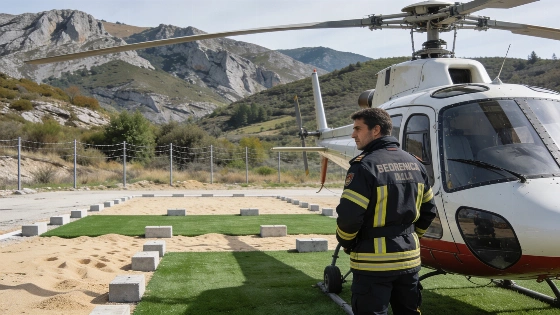
The El Oterico helibase in León, built for wildfire response, has only just become partially usable after major delays and safety issues. Firefighters report critical gaps in infrastructure, risking slower emergency action.
The El Oterico helibase in León, intended as a strategic hub for wildfire response, has only recently become partially operational despite being announced in 2022 and costing nearly two million euros. With the summer fire season underway, firefighters have faced significant obstacles: the base was not ready for aerial operations until just days ago, and even now, key safety and infrastructure elements remain unfinished. According to those working on site, the delays have forced crews to drive for over an hour and a half to reach fires that could be accessed by helicopter in just 15 minutes.
As reported by EL PAÍS, the base’s main landing areas are compromised by a sand-based surface, which has rendered most of the helipads unusable. The only perimeter protection is an electric fence installed by the firefighters themselves to keep livestock out, but this does nothing to prevent unauthorized access by people. The lack of proper fencing or surveillance raises concerns about potential vandalism or accidents, especially given the presence of helicopters valued at nearly two million euros each.
Basic amenities are also lacking. The base has no reliable phone line, poor mobile coverage, and non-functioning showers. Fuel storage tanks remained unsealed for weeks, and the refueling hose only reaches one of the seven helipads, forcing crews to move aircraft manually. The water pump is out of order, so after long shifts battling fires, staff must return home without being able to wash. These issues have left the team frustrated and, in their view, have undermined the region’s ability to respond quickly to wildfires.
The problems at El Oterico are compounded by the closure of the previous Camposagrado base, which was shut down due to a kerosene leak contaminating the water supply. While the initial transfer of personnel was understood, firefighters now question why the old base was closed before the new one was fully functional. They argue that the current situation leaves large areas, especially those hit by the 2025 fires, dangerously exposed. The artificial grass solution for the helipads, fixed with 10-centimeter nails, has proven unreliable—blocks of concrete now hold it down to prevent it from becoming airborne and damaging helicopters.
Despite the recent partial opening, only one of the seven helipads is in use, and the team describes a patchwork approach to making the base minimally functional. The lack of effective communication systems and basic facilities means that, even now, the base cannot serve its intended purpose. Firefighters admit that using El Oterico in its current state would have posed unacceptable risks, and many believe returning to Camposagrado would be preferable if the contamination issue is resolved. However, the political challenge of reversing the opening of a new base remains unresolved.
Spain’s wildfire response infrastructure has come under scrutiny in recent years, particularly as climate change increases the frequency and severity of summer fires. León’s mountainous terrain makes rapid aerial deployment essential for containing outbreaks before they spread. The delays and shortcomings at El Oterico highlight the importance of ensuring that new emergency facilities are fully operational before decommissioning existing ones. According to official data, Spain has invested heavily in modernizing its firefighting resources, but the situation in León suggests that implementation on the ground can lag behind planning and announcements. The experience at El Oterico may prompt further review of how such projects are managed and delivered in regions at high risk of wildfires.