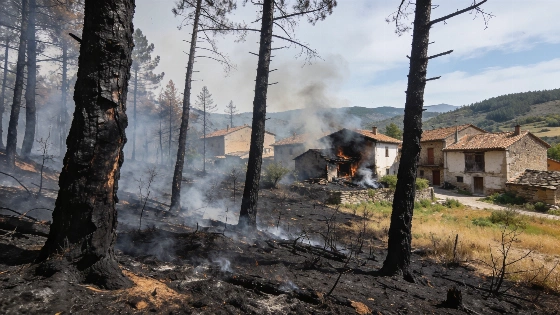
The wildfire in Sierra de Espadán remains active after six days. Fourteen municipalities and several residential areas are still evacuated. Rising temperatures and complex terrain challenge firefighting efforts.
Six days after it began near La Vall d’Uixó, the wildfire in the Sierra de Espadán Natural Park continues to burn, prompting authorities to maintain evacuations across 14 municipalities and several residential zones in Castellón. Emergency teams are focusing on containing new outbreaks in the rugged mountain terrain, where rising temperatures are expected to complicate operations. The perimeter of the fire is established but not yet secure, according to Juan Carlos Valderrama, the regional emergencies councillor, following a late-night meeting of the Cecopi coordination committee.
Efforts to control the blaze are hampered by unpredictable fire behavior and the challenging geography of the park. Antonio Rodrigo, technical director at the Advanced Command Post, noted that while the situation has improved compared to previous days, full optimism remains premature. The Generalitat has not released updated figures for the area burned within the protected park, which spans 31,180 hectares. The latest estimates put the total affected area at 9,300 hectares, with the fire’s perimeter stretching 82 kilometers since Saturday.
Firefighting this week has centered on several key fronts, including the direct threat to Alcudia de Veo, a town at the heart of the park known for its valuable cork oak forests. Eslida, Aín, Alfondiguilla, and Almedíjar—towns with some of the region’s densest cork oak stands—have all been evacuated. The cork oak’s thick, insulating bark and strong regrowth capacity offer some resilience against fire, unlike the more vulnerable pine species common in the area.
During the latest coordination meeting, officials agreed to extend evacuation and confinement orders for the affected municipalities and residential areas. These include Artana, Eslida, Aín, Alcudia de Veo (including the Veo district), Tales, Alfondeguilla, Fuentes de Ayódar, Ayódar, Torralba del Pinar, Sueras, Villamalur, Chóvar, Azuébar, and Almedíjar, as well as the Solaig, Montserrat, and Peña Negra developments in Betxí and the Artesa district of Onda. The restrictions will remain in place until at least 23:59 on July 30, prioritizing resident safety and operational needs.
Authorities have also recommended bottled water consumption in affected areas, especially La Vilavella, and the use of masks in confined zones due to air quality concerns. Security forces, working with local mayors, are organizing convoys to allow evacuated residents to access their homes briefly to care for pets and provide water and food.
Displaced residents have been relocated to new facilities arranged by the Generalitat, including the student residence at Universitat Jaume I de Castellón, the Penyeta Roja center, and the La Vilavella spa, now hosting 149 people. Additional evacuees remain at the Segorbe Seminary (128 people) and in Moncofa (45 people). In Nules, a center provides meals for those staying with relatives, ensuring breakfast, lunch, and dinner for evacuees.
This incident echoes the challenges faced in other parts of Spain, where wildfires have forced mass evacuations and tested emergency response systems. For example, recent events in Ávila and Madrid saw thousands displaced as authorities struggled to contain advancing flames, as detailed in this report on evacuations and shelter arrangements during major wildfires.
Spain’s Mediterranean climate, characterized by hot, dry summers, makes regions like Castellón particularly vulnerable to wildfires. The Sierra de Espadán is one of the largest protected natural areas in the Valencian Community, home to diverse flora and fauna, including extensive cork oak forests. Wildfires in such areas not only threaten local communities and infrastructure but also have long-term ecological impacts, affecting biodiversity and water resources. The ongoing situation in Castellón highlights the persistent risk of wildfires in Spain and the importance of coordinated emergency planning, especially as climate patterns continue to shift.