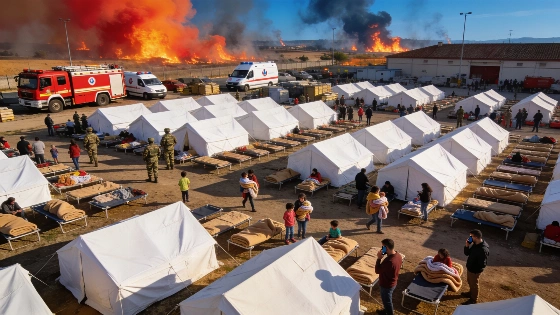
Wildfires in Ávila and Madrid have displaced over 5,000 people. Talavera de la Reina and Escalona now host evacuees as authorities battle to contain the flames. Many remain anxious about their homes and future.
Hundreds of residents from Ávila and Madrid have been forced to leave their homes as a series of wildfires continue to threaten towns near the border with Castilla-La Mancha. The fairgrounds in Talavera de la Reina have become a temporary refuge for around 2,000 evacuees, while Escalona hosts another hundred, following urgent evacuation orders issued over the weekend. The rapid spread of flames and thick smoke have made it unsafe for thousands to remain in their communities, with authorities prioritizing safety and containment efforts.
The situation escalated when the fire in Burgohondo prompted the evacuation of 11 municipalities near the Valle del Tiétar. Although the flames have not directly reached every town, the dense smoke has made living conditions hazardous, leading to the displacement of approximately 5,200 people. Emergency services, including Infocam and the military, have set up beds and essential facilities at the Talavera fairgrounds, where many evacuees now wait anxiously for news about their homes and pets left behind.
Efforts to control the fires have intensified along the border with Madrid, especially after the national government extended the emergency to the province of Toledo. Firefighters have managed to stabilize some fronts, but the risk of reactivation remains high, particularly with forecasts of another heatwave. In Almorox, ground and aerial teams have slowed the advance of the flames, but authorities remain on high alert as conditions could worsen. The regional government has established a new command post in La Iglesuela to coordinate operations in the Toledo area, and containment lines now stretch over 20 kilometers, helping to prevent the Burgohondo fire from entering Castilla-La Mancha.
Among those displaced are residents from the urbanizations of El Pinar and El Romillo, as well as people from Cenicientos and Cadalso de los Vidrios in Madrid and several towns in Ávila. Many have found shelter in sports halls and municipal facilities, where local authorities and civil protection teams provide meals and support. Despite the care received, uncertainty dominates, with evacuees expressing concern over the fate of their properties and livestock. The government has arranged secure corridors for farmers to feed their animals, and the Talavera fairgrounds have been equipped with boxes and corrals for livestock if needed.
Officials have not set a date for when residents can return, emphasizing that safety must be fully guaranteed before any reentry is allowed. The UME is assessing the situation to determine if partial returns are possible, but authorities caution against raising expectations while the threat persists. Meanwhile, the community response has been marked by solidarity, with volunteers and local staff working to ensure evacuees are cared for during this period of upheaval.
The current crisis echoes previous wildfire emergencies in the region. As highlighted in recent coverage of similar evacuations in Madrid and Ávila, the scale and frequency of such incidents have placed increasing pressure on emergency services and local governments.
Spain has faced a growing number of severe wildfires in recent years, often exacerbated by prolonged heatwaves and dry conditions. The affected areas, including the Sierra Oeste of Madrid and the Valle del Tiétar, are known for their dense forests and rural communities, making firefighting efforts particularly challenging. National and regional authorities continue to invest in prevention and rapid response, but the unpredictability of weather patterns and the scale of recent fires underscore the ongoing vulnerability of many Spanish regions to such disasters. For now, the priority remains the safety and well-being of those displaced, as well as the protection of homes, livestock, and critical infrastructure.