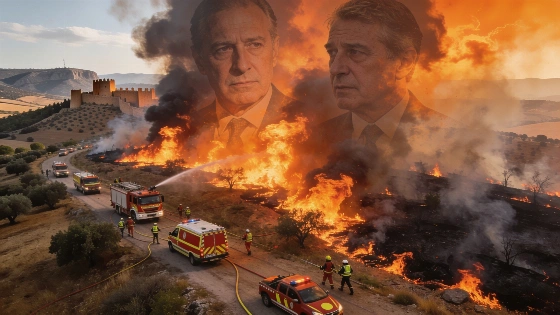
Emergency services in central Spain battled a series of wildfires that forced evacuations and disrupted daily life in several towns across Madrid and Ávila provinces. Spanish Prime Minister Pedro Sánchez and Community of Madrid President Isabel Díaz Ayuso visited affected areas as authorities at every level coordinated the response. During the July emergency, about 11,500 people were evacuated across the two regions: more than 10,000 from fires affecting Villa del Prado, Aldea del Fresno, San Martín de Valdeiglesias and Pelayos de la Presa, and around 1,500 from a rural-tourism complex and residential area in El Tiemblo, Ávila. The government declared an emergency situation covering the Community of Madrid and Ávila province.
In Cebreros, Ávila, forest firefighters worked through the night to contain advancing flames, using controlled burns to help keep the fire away from populated areas. Residents watched as the fire approached the town, and some left their homes for safety. In Valdemorillo, Madrid, a bullring became a temporary refuge for evacuees. The wider Ávila fire affected at least 22 municipalities, extending the impact well beyond communities closest to the fire front.
Fire crews from Salamanca and other regions joined local teams, resting between shifts in makeshift accommodation such as sports halls. Smoke and ash also affected air quality in Madrid, blanketing the city at dawn and raising concerns about exposure among vulnerable groups. In the Sierra Oeste area, three fires near Villa del Prado and San Martín de Valdeiglesias merged during July, burning more than 29,000 hectares and prompting evacuations in about 12 municipalities. Navas del Rey reportedly lost 85% of its municipal territory. Ecologist Jaime Manzano and other researchers cited land-management conditions, including insufficient grazing and accumulated vegetation, as factors that can compound severe weather.
Community of Madrid officials, including Ayuso and regional environment and agriculture minister Carlos Novillo, monitored developments from the advanced command post in Cenicientos. Nighttime images from Navaluenga, Ávila, showed flames spreading across forested areas. Spain’s national response reached Situación Operativa 3 (SO3) during the week of 24-30 July, an unprecedented operational level the Ministry for the Ecological Transition described as a grave situation. Emergency operations doubled, while emergency interventions and calls tripled. The Unidad Militar de Emergencias assumed command in the hardest-hit provinces, including Ávila and Madrid. Assistance also arrived from Greece, Italy, Portugal, Serbia, Türkiye and France.
Several reported totals reflect the scale of the Ávila blaze. Reuters reported that sparks from heavy machinery ignited vegetation near Burgohondo on 22 July, about 90 kilometres west of Madrid. Strong winds drove the fire, which later merged with fires near Almorox in Toledo and San Martín de Valdeiglesias. The combined blaze came within 35 kilometres of Madrid. Reuters cited regional estimates of about 63,000 hectares burned by the time hotspots were extinguished on 3 October. Separately, figures attributed to Spain’s Ministry for the Ecological Transition put the Burgohondo fire’s burned area at 33,943 hectares, while regional reporting placed it at nearly 38,000 hectares, with a perimeter of about 160 kilometres. The ministry-derived account dates the fire’s start to 23 July and its official extinguishing to 3 October, a 73-day period. These figures reflect different reported assessments of the fire and are not interchangeable.
Spain’s wildfire-control effort reached more than 10,000 flight hours and 50,259 water drops during 2026, information from figures reported by Europa Press. Meanwhile, many residents spent nights in temporary shelters, unsure when they could return. The response required cooperation between national and regional authorities, along with support from neighbouring provinces. Emergency teams adjusted tactics as conditions changed.
The consequences continued after officials declared the fires extinguished. Heavy rain exposed erosion and infrastructure problems in burned areas, while residents in parts of the Tiétar area described their tap water as unusable. Recovery has also raised questions about the cost of repairing public infrastructure and restoring livelihoods. Cebreros mayor Pedro José Muñoz said state assistance covered only about half the cost of replacing damaged municipal infrastructure. He criticized the lack of dedicated compensation for damage to homes and possessions, evacuations, and agricultural and commercial losses. Muñoz described the aid as insufficient and said affected municipalities felt neglected. The Ministry of Labour and Social Economy approved employment-related measures for affected people, while the Junta de Castilla y León said its recovery effort would address economic, social and emotional needs as well as physical damage.
These fires form part of a broader pattern of extreme wildfire events in Spain, where hot, dry conditions and field management can shape both risk and severity. The current crisis in Madrid and Ávila follows earlier incidents in the region, including those covered in recent coverage of mass evacuations in southwest Madrid. The emergency highlights the challenges facing local communities and authorities as they manage large fires during the summer months.
For residents of affected areas, the immediate priority remains safety and the prospect of returning home. Longer-term recovery will involve repairing infrastructure, addressing environmental damage and restoring economic activity across communities whose homes, farms and businesses were affected.