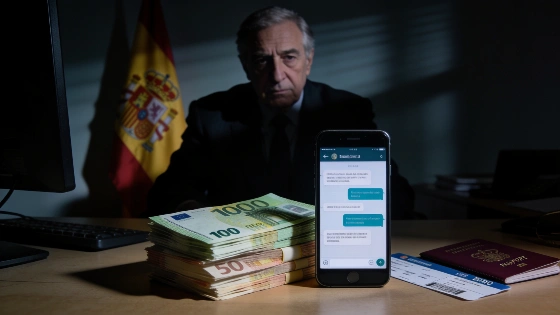
Police-recovered chats show former Spanish Prime Minister José Luis Rodríguez Zapatero and his long-time secretary, Gertrudis Alcázar, closely tracking payments from consulting contracts and international engagements. The messages identify specific sums and trace their origins, including how some were paid.
The chats, which span from 2000 onward, show Zapatero receiving funds from countries such as Peru and Turkey, alongside money from book deals and contracts with international consultancies including Kreab and Thinking Heads. In one exchange from May 2025, Zapatero asks whether a €17,800 payment relates to Turkey. Alcázar clarifies that the Turkish deal was for a higher amount and links the payment to a book contract, noting delays and further transfers expected from other sources.
Police investigators are working to match references in the chats with actual transactions and suspect that some consulting contracts may have masked illicit commission payments for political favors. The investigation also highlights Zapatero’s use of cash. In one message, Alcázar asks whether a travel expense should be reimbursed in cash or by transfer, and Zapatero replies that he will pay in cash.
A separate inquiry in Madrid concerns the alleged disclosure of reserved information from police reports produced by Spain’s Economic and Fiscal Crime Unit (UDEF). As reported by El Plural, Judge Margarita Valcarce of Madrid’s Investigative Court No. 16 is examining whether protected investigative material, including personal agendas and conversations involving Alcázar, was improperly disseminated. That proceeding addresses the handling of investigative information, separate from the underlying allegations about payments.
The chats also reveal a pattern of rapid trips by Zapatero to the Dominican Republic, often lasting nearly 24 hours and linked to his consulting work. Records show three such express visits between 2024 and 2025, sometimes involving complex flight routes and brief stays on the island. Police say the trips were more frequent and logistically involved than previously acknowledged.
The wider Plus Ultra investigation, led by Judge José Luis Calama, concerns alleged influence over the state-backed rescue of the airline. Reports on businessman Julio Martínez’s testimony have described a €53 million public credit and an alleged commission of 1%, or about €530,000. Those figures relate to allegations in that separate investigation, not the €17,800 payment discussed in the May 2025 exchange. elDiario.es has also reported testimony about a €169,000 payment received in 2025 from a Chinese company connected to mineral trading involving Venezuela. Martínez characterized his trips to Venezuela with Zapatero, seven or eight by his account, as concerning separate matters with distinct agendas.
Judge Calama has also requested records from Spain’s state heritage authorities on institutional gifts accepted by the Presidency of the Government between 2004 and 2011, including formal acceptance records. The request concerns the provenance and treatment of gifts. It is a separate line of inquiry, not a finding that any gift was an illicit payment. In another reported transaction, ABC described a €20,993.50 payment made in 2021 by Agropecuaria Lucena to Whathefav, a communications agency associated with Zapatero’s daughters. Martínez said it paid for designing an olive-oil brand for a company in Benamejí, Córdoba.
Routine discussions about payments from Kreab, Thinking Heads and other entities are interspersed with personal notes, including references to Zapatero’s family and books they shared. The chats point to a close working relationship between Zapatero and Alcázar, who shared a progressive political alignment and a high degree of trust in managing sensitive financial matters.
The investigation into Zapatero’s financial dealings comes amid broader scrutiny of political influence and consulting contracts in Spain. Similar cases have recently drawn attention to the intersection of internal party dynamics and financial decisions, including when a former PSOE insider prepared to testify independently, raising pressure on party leadership.
Spanish law requires public officials to declare income and avoid conflicts of interest, while the boundaries between public duties and private consulting remain under scrutiny. The Presidency’s published information on Zapatero’s former-president’s office identifies two publicly funded posts: a level-30 adviser and a level-18 administrative worker. As reported by El Confidencial Digital, that administrative arrangement is distinct from private consulting activity and does not, by itself, establish how any private payment was funded.