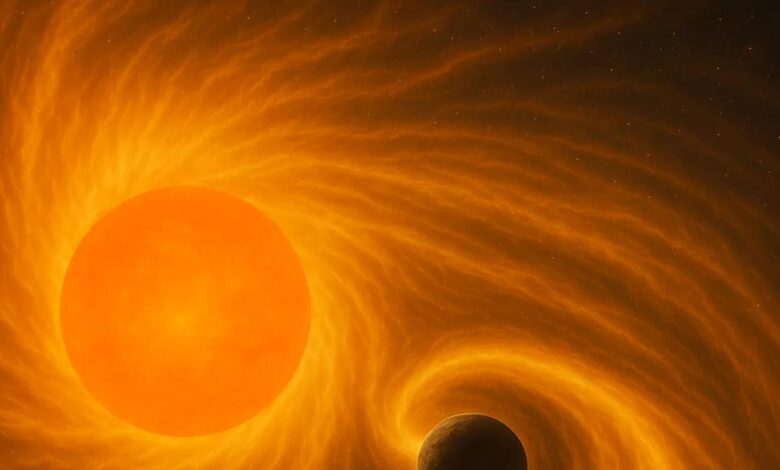
For the first time in the history of astronomy, scientists have succeeded in capturing an image of a stellar companion located in close proximity to a massive red giant on the asymptotic branch. This achievement became possible thanks to the ALMA radio telescopes, which allowed researchers to observe details previously hidden behind dense clouds of gas and dust.
Binary star systems are quite common, especially among stars with a mass greater than 0.8 solar masses. Most of these stars eventually evolve into giants with enormous size and brightness tens of thousands of times greater than the Sun. However, detecting a small companion near such an object is extremely difficult due to intense stellar winds and turbulence in the surrounding space.
Researchers were particularly interested in the star Pi¹ Gruis A, located about 530 light-years from Earth. Once similar to our Sun, its radius has now increased 400-fold, and its luminosity is 7,000 times greater. A dense shell of gas and dust forms around it, making observations more challenging.
Previously, astronomers noticed unusual fluctuations in the brightness of certain giants, which could indicate the presence of a nearby companion. Pi¹ Gruis A turned out to be one such candidate, prompting a team of specialists to conduct a more detailed investigation using ALMA.
Observations have revealed a companion star, designated Pi¹ Gruis C. It orbits the giant at a distance of 6.81 astronomical units, which is roughly the distance from the Sun to Jupiter. Its orbital period is nearly 12 years, and an accretion disk is forming around the companion star itself.
Preliminary data suggest that Pi¹ Gruis C could be either a yellow-white main-sequence star of spectral type F or a massive white dwarf. Further observations using the space telescope are planned to accurately determine its nature.
Scientists were surprised by the almost perfectly circular orbit of the companion. In similar systems, trajectories are usually elongated, as confirmed by computer models and observations of other binaries at late evolutionary stages. This discovery challenges existing theories and calls for a revision of models describing how stars interact in binary systems.
The presence of a companion during this phase of the giant’s life can significantly influence mass loss, the structure of the stellar wind, and the formation of planetary nebulae. The obtained image opens up new opportunities for studying the dynamics of such objects and may lead to a revision of our understanding of the final stages of stellar evolution.