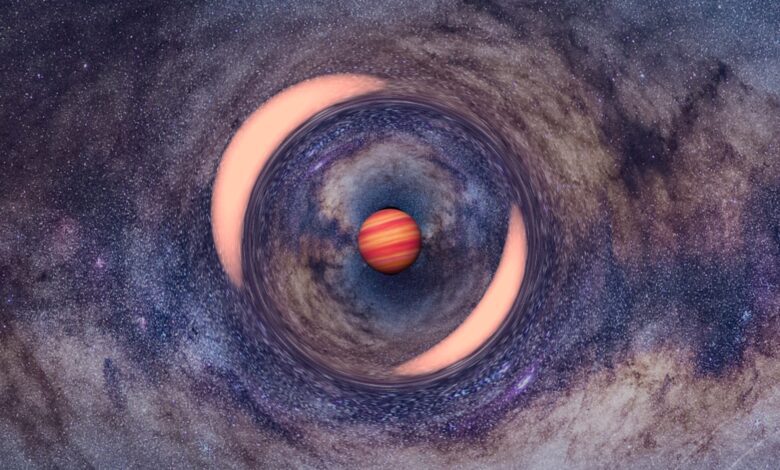
A groundbreaking event has taken place in the world of astronomy, one that could radically alter our understanding of the universe. A team of researchers has discovered and thoroughly studied a mysterious planet unbound to any star. This object, comparable in size to Saturn, is located nearly 10,000 light-years from Earth. Until now, such rogue planets existed only as hypothetical phantoms, but scientists have now managed not only to confirm its existence, but also to determine its mass and precise distance.
Planets usually orbit stars, forming the familiar systems we know. However, hints at the existence of so-called free-floating planets—worlds not bound by the gravity of a star—first emerged in the early 21st century. In 2024, astronomers detected a strange distortion in the light of a distant star. This phenomenon, known as gravitational microlensing, suggested that a massive object was passing between us and the star. Observations were carried out using both ground-based telescopes and the Gaia spacecraft of the European Space Agency, which had completed its mission by that time.
Technology and Discoveries
Modern exoplanet search methods are mainly designed for objects that are closely associated with stars. However, free-floating planets neither emit their own light nor reflect enough starlight to be spotted directly. The only way to detect them is by registering how their gravity bends the light from distant stars, temporarily boosting the stars’ brightness. Until recently, this method allowed scientists only to suspect the presence of such objects, but not to determine their exact characteristics.
This time, scientists took it a step further. They observed an event designated as KMT-2024-BLG-0792 and OGLE-2024-BLG-0516 from two separate locations simultaneously: from Earth and from space. This made it possible to carry out a kind of astronomical triangulation and calculate how far away the mysterious planet is. It turned out to be about 9,950 light-years from us, toward the center of the Milky Way. The object’s mass is about 70 times that of Earth, slightly less than the mass of Saturn.
The galaxy is full of loners
The discovery of such an object is not just a scientific sensation. It supports the theory that there may be far more free-floating planets in our galaxy than stars. According to calculations, these worlds could outnumber stars by several times. How do they form? Some are likely ejected from their systems as a result of chaotic gravitational interactions among young planets. Others may take shape directly from clouds of gas and dust, skipping the star phase entirely.
So far, astronomers have identified only a dozen candidate free-floating planets, and only now—for the first time—have they been able to determine their parameters with such precision. This breakthrough was made possible by combining ground-based and space observations, alongside advances in microlensing analysis techniques. Scientists are confident: with the advent of new telescopes capable of scanning the sky in the infrared spectrum, the number of such discoveries will increase dramatically.
The future of research
In the coming years, new instruments will be launched into orbit, enabling the search for free-floating planets with unprecedented efficiency. The American Nancy Grace Roman telescope, set to launch in 2026, will be able to survey vast stretches of the sky in infrared light, doing so a thousand times faster than the famed Hubble. China’s Earth 2.0 satellite, planned for launch in 2028, will also join the hunt for rogue planets.
Each new discovery in this field not only expands our understanding of the Universe, but also challenges our established ideas about how planetary systems form and evolve. It is possible that among these free worlds lie the keys to understanding the origins of planets—including our own Earth. And perhaps, somewhere in the dark corners of the Galaxy, far from the stars, there are even more astonishing objects that we have yet to imagine.
RUSSPAIN reminds that Andrzej Udalski is a renowned Polish astrophysicist, professor at the University of Warsaw, and one of the leading experts in the search for exoplanets and variable stars. He is the co-author of numerous scientific publications and heads major international astronomy projects, including OGLE (Optical Gravitational Lensing Experiment), which has made a significant contribution to the study of the structure and evolution of our Galaxy.