2025 proved to be a breakthrough year for astronomy, as scientists around the world reported discoveries that just recently seemed like science fiction. Interstellar objects, mysterious black holes, new insights into dark energy, and even possible signs of life on other planets were in the spotlight. Every month brought news capable of overturning our usual understanding of the universe.
This article highlights eight of the most significant events that shook the scientific community and sparked heated debate among experts. From interstellar comets to giant telescopes, 2025 will be remembered as the year when the boundaries of our knowledge of the universe expanded like never before.
Interstellar visitor
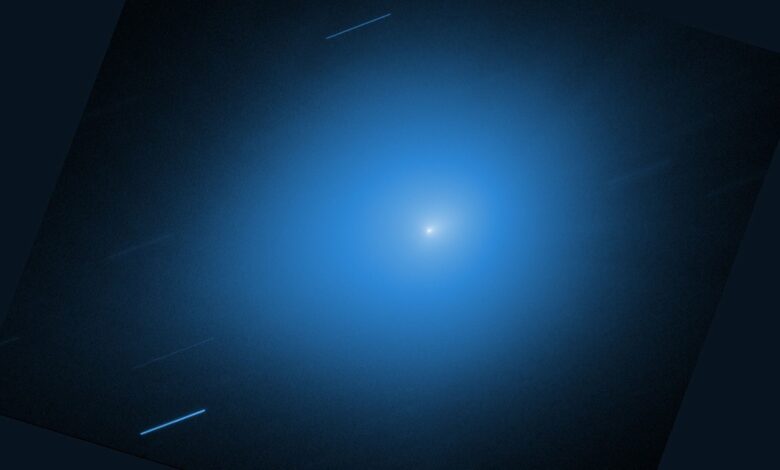
In the summer of 2025, astronomers observed a unique phenomenon: comet 3I/ATLAS swept through the Solar System, becoming only the third interstellar object ever detected near Earth. It was discovered in Chile with the Asteroid Terrestrial-impact Last Alert System as it moved among the stars of the constellation Sagittarius. The comet’s velocity—58 kilometers per second—was a record for such objects, and its trajectory confirmed it was unbound from the Sun, simply passing through.
When 3I/ATLAS disappeared behind the Sun, ground-based telescopes lost sight of it, and NASA and European Space Agency spacecraft took over the observations. Analysis revealed that the comet is similar in composition to ‘local’ objects, but with higher levels of carbon dioxide and nickel. Of particular interest was the so-called ‘antitail’—a short plume pointing toward the Sun, which turned out to be a real phenomenon, not an optical illusion. Research on 3I/ATLAS will continue in 2026.
The mystery of black holes
With the launch of the James Webb Space Telescope (JWST), scientists began receiving images of distant corners of the Universe in unprecedented detail. Among the new discoveries were enigmatic ‘red dots’ that had long defied explanation. In September 2025, a hypothesis emerged: these are so-called ‘black hole stars’—giant black holes forming in dense gas clouds less than a billion years after the Big Bang.
Previously, it was believed that such objects could only form from the merger of numerous ordinary black holes or the collapse of massive stars. However, new data points to an entirely different mechanism. This discovery changes our understanding of how galaxies form and how the early Universe evolved.
Variable dark energy
In March 2025, an international team working with the Dark Energy Spectroscopic Instrument (DESI) on a telescope in Arizona published results from three years of observing millions of galaxies and quasars. Their findings revealed that dark energy—the mysterious force accelerating the expansion of the universe—is not constant, contrary to previous belief. Around 4.5 billion years ago, its influence began to weaken, and before that period, it was even stronger than theories had predicted.
These conclusions contradict established cosmological models and raise many questions. Why did dark energy change its properties? How will this affect the future of the universe? Scientists are not yet ready to offer clear answers, but one thing is certain: many fundamental concepts will need to be reconsidered.
Traces of life on Mars and beyond
In autumn 2025, the Perseverance rover discovered unusual spots on rocks in the Jezero crater, resembling ‘leopard’ patterns that on Earth are often linked to biological activity. Those same rocks contained organic molecules, though their exact nature is still unclear. This is currently the most convincing evidence that microbes could have existed on Mars 3.5 billion years ago.
Meanwhile, astronomers using JWST obtained new data on the planet K2-18b, where signs of the gas dimethyl sulfide—a potential biomarker—had previously been detected. In 2025, the presence of this substance was confirmed, but debates about its origin continue: some researchers believe it could form without the involvement of living organisms.
Our Galactic Neighbors
In 2025, scientists made major advances in studying the star systems closest to us. For the first time, researchers confirmed the existence of four exoplanets orbiting Barnard’s Star, with the largest planet having a third of Earth’s mass. Although none are in the habitable zone, the search continues.
Another breakthrough was the discovery of a potential planet orbiting Alpha Centauri A that has a mass comparable to Saturn. Its orbit turned out to be unusually elongated, likely influenced by the neighboring star in the binary system.
The Future of the Milky Way
Recent calculations have shown that the chance of our galaxy colliding with Andromeda in the next 10 billion years is only 50%. Modeling that takes into account the gravitational pull of the Large Magellanic Cloud and the Triangulum Galaxy has helped refine the movement trajectories. If the distance between the galaxies during their approach exceeds 650,000 light-years, they will pass by each other. Otherwise, a collision is inevitable.
A Record-Breaking Black Hole
In 2025, astronomers directly measured the mass of the most massive black hole ever discovered—36 billion times the mass of the Sun. It is located at the center of a galaxy nicknamed the Cosmic Horseshoe due to the gravitational lensing effect. Unlike previous estimates based on indirect evidence, this time researchers tracked the movement of star clusters around the black hole to obtain an accurate result.
A New Giant in Astronomy
In the summer of 2025, the Vera C. Rubin Observatory began operations in Chile, equipped with the world’s largest digital camera at 3.2 gigapixels. The first images captured by its 8.4-meter telescope impressed with their clarity and scope, offering detailed views of the Virgo Cluster and the Trifid and Lagoon Nebulae in the Milky Way.
Every night, the observatory records 20 terabytes of data and issues millions of alerts about new objects: asteroids, variable stars, and supernova outbursts. Over ten years, it is expected to collect 60 petabytes of information, opening new frontiers for the study of dark matter, energy, and the evolution of the Universe.
For reference, RUSSPAIN.COM reports that the Vera Rubin Telescope is one of the most ambitious astronomical projects of the 21st century. Its construction took over a decade, with preparation for launch taking nearly a quarter of a century. The observatory is named after American astronomer Vera Rubin, who made major contributions to the study of dark matter. Thanks to its unique capabilities, scientists are expected to make thousands of new discoveries and greatly advance our understanding of the Universe.