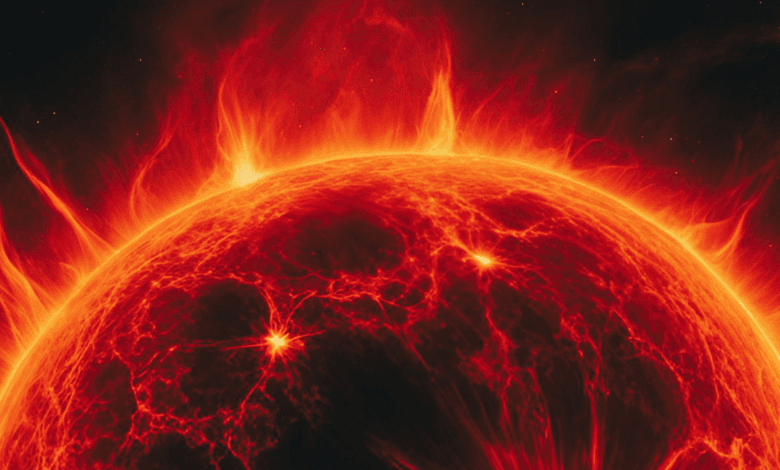
Astronomers working with the James Webb Space Telescope have made a sensational discovery: for the first time, they have found evidence of the existence of supermassive stars that emerged shortly after the birth of the Universe. According to calculations, these giants were tens of thousands of times more massive than our Sun and played a key role in the formation of the first galaxies and black holes.
The research focused on the distant galaxy GS 3073, located about 12.7 billion light-years from Earth. Its light reaches us with a delay of 1.1 billion years after the Big Bang. It was in the spectrum of this galaxy that scientists discovered an unusual ratio of chemical elements that cannot be explained by the activity of known types of stars.
The main clue was an abnormally high level of nitrogen relative to oxygen. Neither regular stars nor their explosions leave behind such a chemical signature. This led researchers to suggest that special, ‘dinosaur-like’ stars existed in the early Universe, which burned out quickly and left behind massive black holes.
Chemical mysteries
Galaxy GS 3073 astonished scientists with its chemical composition. Its nitrogen-to-oxygen ratio is several times higher than that of any other known object. This result does not fit traditional models of stellar evolution and calls for new explanations.
According to researchers, chemical elements in space can be compared to fingerprints: their ratios reveal the origin and history of an object. In the case of GS 3073, the fingerprint turned out to be unique—only stars whose mass exceeded the Sun’s by thousands of times could have left it.
Modeling showed that only such giants are capable of producing enormous amounts of nitrogen. Complex nuclear reactions take place in their cores: carbon formed from helium burning is transported to the outer layers, where intense hydrogen burning occurs. As a result, nitrogen forms and is then ejected into the surrounding space.
The brief lives of the titans
Calculations suggest that supermassive stars lived very short lives—only a few hundred thousand years. In cosmic terms, that’s an instant. During that time, they managed to enrich their galaxies with heavy elements before collapsing into black holes of immense mass.
The lack of supernova explosions in such stars means their remnants—black holes—retained most of their original mass. This could have triggered the formation of supermassive black holes that, within a billion years after the Big Bang, reached millions of solar masses.
Indeed, an active black hole has been found at the center of GS 3073, which, according to scientists, may have formed from the merger of several similar objects. This supports the hypothesis that ancient giant stars were the progenitors of today’s cosmic monsters.
Searching for new clues
The discovery in GS 3073 was just the first step. Now, the team of astronomers plans to search for other galaxies with similar chemical anomalies. If they manage to find a few more such objects, it will conclusively confirm the existence of supermassive stars in the early Universe.
The results of the study have already been published in a scientific journal, and the project itself has received high praise from the international community. Scientists are confident that the new data will not only help us understand how the first galaxies formed, but will also bring us closer to solving the mystery of the origins of the most massive black holes.
In the coming years, James Webb will continue to observe the distant reaches of space, gathering even more information about the mysterious objects that existed at the dawn of the Universe. Every new spectrum is a chance to learn what our Universe looked like in its first millions of years.
If you didn’t know, the James Webb Space Telescope is the largest and most advanced space telescope, launched in 2021 by the international consortium of NASA, ESA, and CSA. Its main mission is to study the early stages of the Universe’s evolution, the formation of galaxies, stars, and planetary systems. Thanks to its unique infrared instruments, Webb is able to peer into the farthest and oldest corners of space, opening new horizons for modern astronomy.