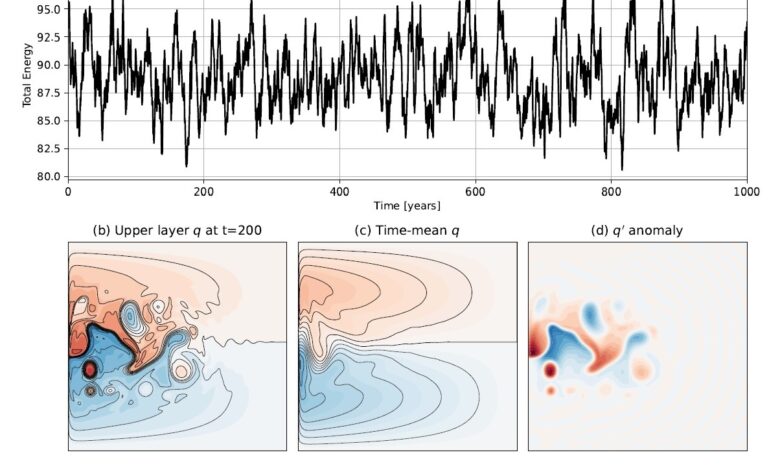
The world’s oceans play a key role in shaping Earth’s climate. Massive currents like the Gulf Stream transport heat between the equator and polar regions, influencing weather conditions across the globe. Yet beneath this grand picture lies a complex dynamic: inside the ocean, swirling eddies constantly form and dissipate—much like atmospheric cyclones and anticyclones, but operating underwater.
These eddies, known as mesoscale eddies, create internal variability that makes long-term forecasting much more challenging. When researchers analyze changes in oceanic processes, they must separate regular responses to external factors—such as global warming or shifting winds—from random fluctuations driven by internal dynamics.
Modern climate models are unable to account for every tiny detail—the number of eddies in the ocean is enormous, and their behavior is chaotic. That’s why scientists use special simplified approaches to describe their impact. However, it’s precisely these approximate methods that become a major source of uncertainty in predictions.
A team of specialists in oceanography and mathematics decided to approach the problem differently. Instead of refining existing models, they set out to determine whether it was even mathematically possible to isolate only the predictable portion of the ocean’s response. To do this, the team ran a series of numerical experiments using an idealized ocean basin model, launching 120 simulations with different initial conditions. By averaging the outcomes, they extracted the system’s deterministic response, while the differences between the simulations revealed the degree of chaos.
During their experiments, the scientists tested how the ocean responds to two types of external influences. In the first scenario, they simulated a slow, large-scale change in wind; in the second, an impact resembling the characteristics of the eddies themselves. They found that with large-scale forcing, the ocean’s response was predictable: wind energy initially accumulates in the main currents and then gradually shifts into eddy activity. Even simplified models showed high accuracy in this scenario.
However, when exposed to eddy-like forcing, the situation changed dramatically. The averaged circulation hardly responded, with all the energy immediately transferring into chaotic processes. In this case, simplified models significantly overestimated the system’s response because they failed to account for the rapid conversion of energy into turbulence.
The authors note that the ability to predict changes in the ocean depends on the scale and nature of external influences. If changes occur slowly and over vast areas, forecasts remain fairly reliable. However, when rapid and localized impacts are involved—such as extreme weather events or glacial melt—chaotic processes take over, sharply reducing the accuracy of models.
The study highlights the need to develop more sophisticated and dynamic models capable of accounting for the interaction between major currents and eddies in real time. Only in this way can the accuracy of long-term climate forecasts be improved and a better understanding gained of how the ocean will respond to climate change in the future.
Going forward, scientists plan to test their findings using more complex global models. Their work opens up new prospects for refining climate forecasts and provides insight into the fundamental limitations science faces when attempting to predict the planet’s future.