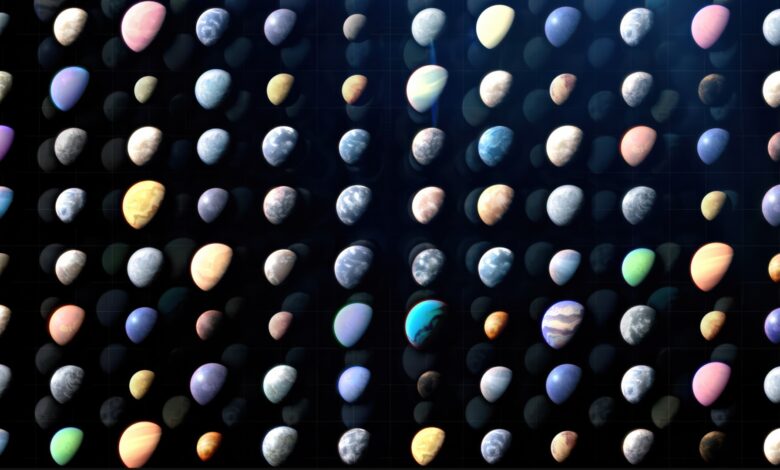
2025 marked a true breakthrough for astronomy: the number of confirmed exoplanets recorded by NASA surpassed 6,000, with thousands more still awaiting confirmation. In the three decades since the first discovery of a planet orbiting a Sun-like star, researchers have made remarkable progress. Thanks to the Kepler and TESS telescopes and new instruments, scientists have identified entirely new classes of worlds with no counterparts in our own system. These include super-Earths, mini-Neptunes, hot Jupiters, and planets with unusual orbits that are prompting a rethink of planet formation theories.
This year, experts have been drawn to exoplanets that not only stand out for their characteristics but also raise new questions about the origins and evolution of planetary systems. Some seem straight out of science fiction, while others upend earlier ideas about where life could exist beyond Earth.
Double suns
In 2025, new ‘Tatooine’ worlds—planets orbiting two suns—were added to the exoplanet catalog. One standout was 2M1510 (AB) b, discovered in April. This planet orbits a pair of brown dwarfs, often referred to as ‘failed stars’. Rather than following a typical orbital plane, it circles above the poles of its suns. Astronomers observed the unusual motion of the stars with the Very Large Telescope in Chile, leading them to theorize that the cause might be a hidden planet flung into such an orbit by an ancient gravitational collision.
Later that same year, another research team detected three Earth-sized planets in the TOI-2267 system, located just 73 light-years away. All three worlds transit both stars, even though such close binary systems are typically considered extremely unstable for planet formation.
The massive HD 143811 (AB) b was also added to the list, having long gone unnoticed in archival data. It was detected using the Gemini Planet Imager in Chile. This planet, six times larger than Jupiter, orbits a pair of young stars that circle each other every 18 days, while the planet itself completes an orbit in 300 years. How such a giant could survive in such a complex system remains a mystery.
Searching for signs of life
The exoplanet K2-18b has once again come into the spotlight after a Cambridge-based team reported possible signs of life in its atmosphere. Using the James Webb Telescope (JWST), scientists detected gases associated with marine biology on Earth—dimethyl sulfide and possibly dimethyldisulfide. This sparked intense debate: some experts believe such substances may indicate life, while others point to possible non-biological sources or insufficiently precise data.
Despite the controversy, K2-18b remains one of the most intriguing targets for study. It’s a sub-Neptune—a class of planets not found in our solar system. New JWST observations, already collected, could shed light on the true nature of this world’s atmosphere.
At the same time, hopes for habitability on TRAPPIST-1e—one of seven planets orbiting a red dwarf 40 light-years from Earth—have been called into question. Initial JWST data hinted at the presence of methane, but subsequent studies revealed that the signal was most likely distorted by the star’s own radiation. Computer modeling showed that methane cannot persist on this planet due to intense ultraviolet radiation, and if an atmosphere exists, it is extremely thin and difficult to detect.
Nearest neighbors
In 2025, astronomers gained a clearer understanding of the Proxima Centauri system—the star closest to the Sun, located 4.2 light-years away. The new NIRPS spectrograph, installed at the La Silla observatory in Chile, confirmed the existence of the planet Proxima b, which lies in the habitable zone, as well as the smaller Proxima d. Meanwhile, a previously suspected third planet was removed from the list. This became a key technical breakthrough: for the first time, scientists recorded the subtle gravitational pull of small rocky planets on red dwarfs, opening up new opportunities to search for Earth-like worlds.
Planets with tails
This year, astronomers discovered rare exoplanets so close to their stars that they lose mass, forming long tails. BD+05 4868 Ab, found by TESS at a distance of 140 light-years, completes an orbit around its star in just 30.5 hours. Due to its extreme proximity, the planet’s surface evaporates, with material streaming into space and creating a tail up to 9 million kilometers long. Scientists believe the planet may completely vanish within 1–2 million years, and analyzing its tail will, for the first time, allow researchers to study the composition of a distant world’s interior.
Another example is WASP-121b (Tylos), an ultra-hot Jupiter located 858 light-years away. Data from JWST revealed the planet has two massive helium tails: one extends behind and the other in front—a phenomenon rarely observed. The first is shaped by the star’s radiation and wind, while the second is drawn ahead by the star’s gravity.
Atmosphere on a lava world
TOI-561b is another mystery of the year. This small planet orbits one of the oldest stars in the Galaxy so closely that its year lasts less than an Earth day, and temperatures exceed 1,700 degrees Celsius. By all calculations, it shouldn’t have an atmosphere, but JWST detected that the planet’s day side is cooler than expected, pointing to a dense atmosphere capable of redistributing heat. If confirmed, this would be the first direct evidence of a long-lived atmosphere on a hot rocky world unlike any planet previously known.
The birth and death of worlds
This year, astronomers witnessed two unique events: the formation and destruction of planets. Using the Magellan telescopes in Chile and the Large Binocular Telescope in Arizona, they were able to directly observe the young planet WISPIT 2b for the first time, which is still forming in a dust disk 437 light-years away. It is already five times more massive than Jupiter and is located in a ring where it gathers material for further growth. Another world may be forming nearby, indicating the complex process involved in the birth of planetary systems.
Around the same time, another team observed the white dwarf LSPM J0207+3331, the remnant of a massive star 145 light-years from Earth. Heavy elements were detected on its surface, indicating the recent fall of debris from a destroyed planet or asteroid. Scientists believe that gravitational changes after the star’s death can send remaining bodies onto unstable orbits, leading to collisions and their destruction.
By the way, NASA (National Aeronautics and Space Administration) is the leading US space agency, focused on exploring the universe, launching satellites, and interplanetary missions. Over the past decades, its Kepler and TESS programs have led to the discovery of thousands of exoplanets, while the James Webb telescope made it possible to study their atmospheres for the first time. In 2025, NASA continues to invest in new instruments and international projects to unlock the mysteries of distant worlds and bring humanity closer to answering the question of life beyond Earth.