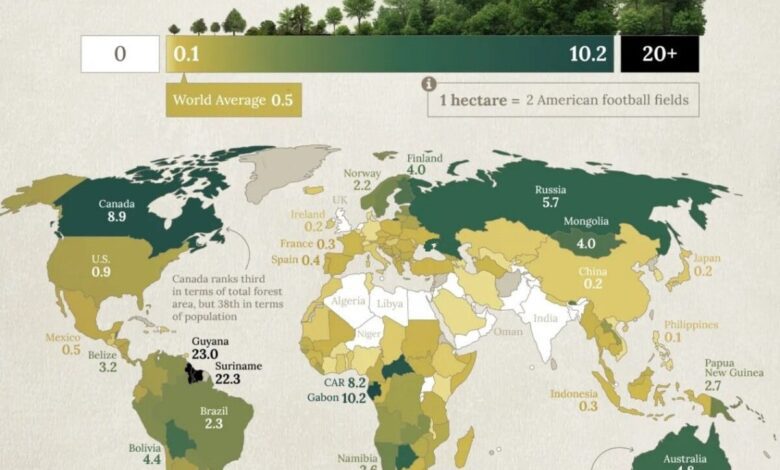
The global distribution of forests per capita is striking: some countries are awash in greenery, while others must conserve every hectare. An infographic based on FAO data clearly shows where people have the most forestland per person. On average, there is just half a hectare of forest for every person on Earth, but there are countries where this figure is tens of times higher.
Leading the list are Guyana and Suriname, two small South American countries where each resident accounts for more than 22 hectares of forest. This is due to a combination of vast tracts of tropical rainforest and a small population. Both countries are part of the Guiana Shield—one of the largest and best-preserved areas of primary tropical forest on the planet. Here, forests cover much of the land, while the population density remains extremely low.
Canada and Russia are also among the world leaders in per capita forest resources. In Canada, there are 8.9 hectares per person, and in Russia—5.7 hectares. Although their populations are much larger than those of Guyana and Suriname, their vast forested areas allow them to maintain strong positions in the rankings. Both countries are known for their expansive taiga and boreal forests, which play a key role in the global carbon balance.
The Geography of Forest Giants
The top 10 countries with the most forest area per capita are mainly those with low population density and vast untouched territories. In addition to the previously mentioned Guyana, Suriname, Canada, and Russia, this list includes Gabon, Bolivia, the Central African Republic, and Finland. In Africa and South America, such figures are a result of both natural conditions and the history of land use.
In Europe, Finland leads with about 4.5 hectares of forest per person. This is due not only to its extensive forests but also to the country’s relatively small population. By contrast, in most European countries—especially in Western and Southern Europe—the amount of forest per capita is significantly lower because of high population density and intensive land use.
Reasons for uneven distribution
The main factors influencing the distribution of forests per capita are the size of the country, climate conditions, historical land use, and demographic characteristics. Countries with harsh climates and difficult agricultural conditions tend to retain more forests. Meanwhile, in densely populated regions where land is heavily used for agriculture and construction, forested areas shrink.
In South America and Africa, many countries still have vast untouched forests, largely due to low population density and limited infrastructure development. However, these regions frequently face the threat of deforestation and forest degradation caused by economic pressures and population growth.
Global challenges and prospects
Despite the impressive achievements of some countries, the world’s forest resources continue to decline. Deforestation, climate change, and population growth are putting pressure on ecosystems. International organizations and governments are developing programs to protect and restore forests, but the success of these initiatives largely depends on political will and the economic capacities of the countries involved.
At the same time, countries that lead in forest area per capita are becoming key players in global environmental affairs. Their forests serve as the planet’s “lungs,” absorbing carbon dioxide and sustaining biodiversity. Preserving these areas is a responsibility of both national and global importance.
Notable facts
It should be noted that a high ratio of forests per capita does not always indicate effective resource management. In some countries, forests remain poorly researched and weakly protected, making them vulnerable to illegal logging and other threats. Meanwhile, nations with smaller forest areas often invest significant resources into their conservation and recovery.
In case you didn’t know, Visual Capitalist is an international media company specializing in creating infographics and analytical materials on economics, the environment, and global trends. Their visualizations are regularly used by leading global media outlets and educational platforms. Founded in Canada, the company has become one of the most authoritative sources of data in the field of visual analytics in recent years.