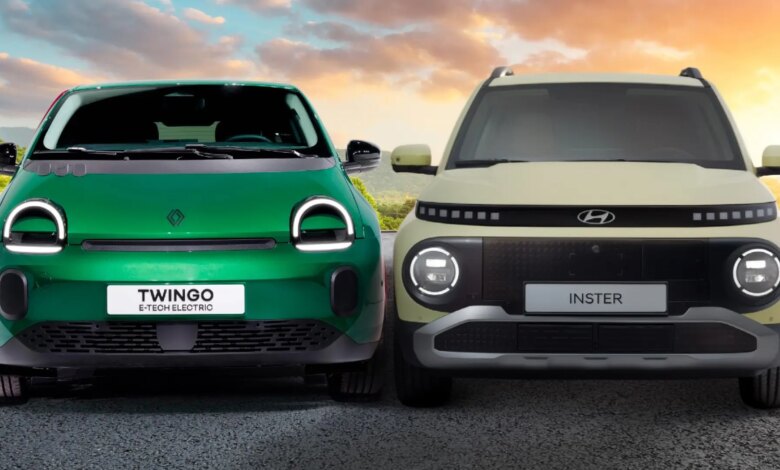
Electric vehicles are rapidly conquering the streets of Spanish cities, and today the market is seeing an increasing number of models that don’t require exorbitant investment. In the under-20,000 euro segment, the competition is particularly fierce. Two contenders for the title of best city EV—Renault Twingo and Hyundai Inster—offer different visions of what the ideal metropolitan car should be. Both are compact, agile, and promise enough range for daily journeys, but their differences are evident from the very first encounter.
Buyers considering making the switch to electric are increasingly paying attention not only to price, but also to convenience, equipment, and style. In this review, we present an honest comparison of two models that might just change the way people think about affordable electric cars.
Design and space
The Renault Twingo immediately stands out with a recognizable silhouette that harkens back to the legendary 90s model. The French manufacturer has bet on nostalgia, adding modern touches: a bright central panel in body color, a digital dashboard, and a multimedia system compatible with Android Auto and CarPlay. Inside, the spirit of the original Twingo is unmistakable—but adapted for the 21st century.
The Hyundai Inster, by contrast, looks like a visitor from the future. Its design evokes Japanese kei cars, and the pixel-style headlights and sharp lines give the vehicle a distinctive retro vibe. The interior is restrained yet high-quality: two large digital displays, a minimalist approach, and thoughtful ergonomics. Despite being slightly narrower, the Inster offers more legroom for rear passengers, though it feels more cramped shoulder-to-shoulder compared to the Twingo.
Technical specifications
The Renault Twingo is equipped with an 82-hp electric motor and a 27.5 kWh battery, providing up to 263 km of range on the WLTP cycle. Charging from a wall unit takes between 2.5 to 3 hours, and with the optional Advanced Charge package (available for an extra fee), you can recover up to 80% charge in just half an hour. Standard features include two digital panels, an adjustable rear bench, and a basic suite of electronic assistants.
The Hyundai Inster offers two power options: 97 and 115 hp. Depending on the battery chosen (42 or 49 kWh), the range varies from 327 to 370 km. Fast charging is available at up to 85 kW, letting you replenish up to 80% of the battery in the same 30 minutes. The base model already includes climate control, a digital instrument panel, driving assistants, and even V2L capability — the option to power external devices from the car’s battery.
Features and comfort
When it comes to equipment, both cars will satisfy even demanding drivers. The Twingo in the techno version boasts the OpenR Link multimedia system with Google integration, adaptive cruise control, a rearview camera, and automatic climate control. A key feature is the sliding rear bench, which allows the trunk volume to be adjusted from 305 to 360 liters.
The Inster, in its top Tecno trim, offers LED headlights, a 360-degree camera system, heated seats and steering wheel, as well as an extensive suite of electronic assistants: from lane keeping to road sign recognition. The trunk here is slightly smaller — from 280 to 351 liters — but the difference is negligible for city needs.
Practicality and charging
For urban residents, not only range but also charging speed is crucial. The Twingo scores with its simplicity: fast charging is available for a small extra fee, and the standard 11 kW output means you won’t waste time at the socket. Inster, on the other hand, focuses on versatility: fast charging comes as standard, and the V2L feature opens up new use cases — for instance, charging an electric scooter or laptop directly from the car.
Both vehicles fit seamlessly into the infrastructure of modern Spanish cities, where the number of charging stations is growing every month. For those living in the suburbs or who frequently travel further afield, the greater range of the Inster could be a decisive factor.
The urban choice
Renault Twingo and Hyundai Inster — two different approaches to urban mobility. The French electric car appeals with its style, slightly larger trunk, and nostalgia for the past. The Korean competitor bets on technology, driving range, and functionality. Both vehicles handle traffic jams, parking, and daily commutes in Madrid, Barcelona, or Valencia with ease.
A buyer who values individuality and striking design will most likely choose the Twingo. Those seeking maximum autonomy and modern features should consider the Inster. In any case, both options prove that an electric car is no longer a luxury but a practical tool for comfortable living in a big city.
Renault is one of the oldest car manufacturers in Europe, known for innovation and bold design choices. The Twingo model first appeared in 1992 and quickly became a symbol of urban mobility in France and beyond. The modern electric version continues the brand’s tradition, blending its recognizable style with cutting-edge technology. The company is actively investing in the development of electric transport, focusing on accessibility and environmental friendliness. In Spain, Renault maintains a strong position in the compact car market, and the Twingo remains one of the most popular choices among city dwellers.