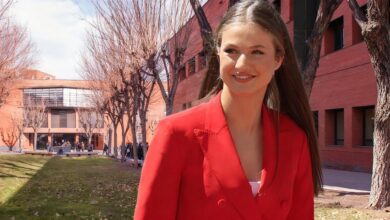
Today, there is only one heroine in the Spanish secular chronicle. Princess Leonor is once again at the center of attention after the palace officially confirmed two major events in her life. First, it became known that after completing her military training, the heir to the throne will continue her education in political science at Carlos III University in Madrid. This choice is already being called historic, as Leonor will become the first in her family to combine military training with an academic career in political science.
A rare photo from Murcia
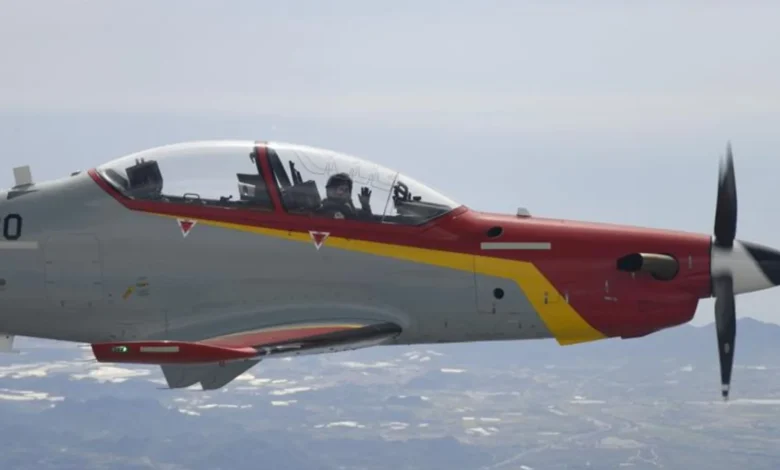
But it wasn’t just her academic plans that sparked a wave of interest. On the same day, new photos were published from the General del Aire y del Espacio Academy in San Javier (Murcia), where the princess made her second solo flight on a Pilatus PC-21. The images show a focused, confident Leonor in a flight suit and helmet, at the controls of a modern training aircraft. The photos were taken from a parallel flying aircraft, allowing for a shot of the heir as she was in full control of the situation in the sky. This act is not just a part of her military program, but also a symbol of maturity and independence, which immediately became a subject of discussion in the Spanish media.
Double workload and new status
As the palace notes, the decision to enroll at Carlos III University has already been agreed upon with the prime minister. At the same time, Leonor will continue to combine her studies with her official duties as heir to the throne, just as she did during her undergraduate years and three years in military academies. This schedule is not only a challenge, but also a clear signal: the princess is ready for a public role and is not afraid of difficult tasks. The public’s attention to the details of her agenda and how she manages this double workload only increases interest.
Aspirations and expectations
Her second solo flight became possible after intensive theoretical training, simulator work, and a series of training flights. According to the palace, the curriculum includes not only learning the technology but also a deep immersion into the structure and traditions of the Air Force. Each new step Leonor takes—whether choosing a university or making another flight—is seen as part of the larger story of the future queen’s coming of age, closely followed by the entire country.
In Spain’s secular context, such news invariably sparks fresh discussion: about the heir’s style, her character, and the way she is changing the traditional scenarios for the royal family. If previously the focus was only on her appearances and gestures at official events, now the attention has shifted to her real decisions and actions that are shaping the image of a modern heir.