Valentine’s Day has long ceased to be just an excuse for romantic dinners and bouquets of roses. Today, this holiday has become a true cultural phenomenon, revealing unexpected facets of national character and attitudes toward love. In some countries, February 14 is an occasion for large-scale events and commerce; in others, it’s a family or even a friendly celebration, while elsewhere the day is simply ignored. Delving deeper, one can discover that behind the familiar hearts and greeting cards lie far more intriguing customs.
Recalling how, in February, the Spanish city of Cuenca transforms into the epicenter of a vibrant and boisterous carnival—where hundreds of ‘devils’ with bells fill the streets with a unique atmosphere—it becomes clear: traditions have the power to surprise and unite people. You can learn more about the unusual rituals of this city in the piece about the Cuenca festival, where the celebration takes on an entirely different meaning.
The geography of the holiday
In most European countries, as well as in the USA, Canada, Australia, and Japan, Valentine’s Day is celebrated on a grand scale. However, even within the same continent, approaches differ. In Spain, France, and Italy, February 14 is primarily a day for lovers, when romantic dinners and gift exchanges are customary. In the UK and the USA, the holiday has long gone beyond couples: here, friends, colleagues, and even pets receive greetings.
In some countries, such as Finland and Estonia, the focus shifts to friendship. There, February 14 is known as Friends’ Day, and greetings are given not only to loved ones but also to kindred spirits. However, there are those who do not celebrate this day at all—for religious or cultural reasons.
Japan: Chocolate nuances
In Japan, Valentine’s Day is a true celebration of chocolate. But it’s not that simple: women give sweets to men, and there’s a strict hierarchy. Cho-Giri Choko is ‘obligatory’ chocolate given to colleagues and acquaintances without romantic intent. More expensive and refined chocolate is reserved for loved ones. A month later, on March 14, White Day arrives, when men return the favor with gifts. This system highlights Japanese attention to detail and social roles.
Brazil: A June celebration
In Brazil, Lovers’ Day is celebrated not in February, but on June 12, on the eve of St. Anthony’s Day, the patron saint of marriage. On this day, cities are filled with romantic promotions, restaurants offer special menus, and couples exchange gifts and declarations. Brazilians are renowned for their passion for festivities, and Lovers’ Day is no exception: the atmosphere resembles a carnival, but with a focus on feelings.
Croatia’s Crystal Hearts
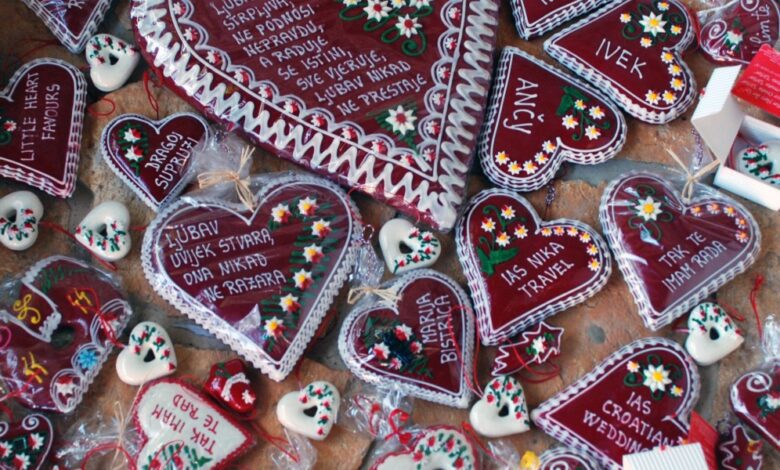
In Croatia, the symbol of the holiday has become colorful gingerbread hearts called licitar. These bright sweets are handmade, decorated with tiny mirrors and messages. Such a gift is more than just a treat; it is a sign of special affection. It’s believed that when looking into the mirror on the gingerbread, one sees the person who holds the most important place in their heart.
Denmark: Flowers and riddles
Danes favor restraint and humor. It is customary on this day to give white snowdrops—a symbol of purity and new feelings. Anonymous letters with rhymed messages take a special place. If the recipient guesses who sent it, an extra gift awaits them. This playful tradition adds intrigue and fun to the celebration.
USA: Cards for everyone
In America, Valentine’s Day has long become a mass phenomenon. Cards, sweets, plush toys, and flowers are must-haves. Not only couples extend their greetings, but also friends, colleagues, and teachers. Schoolchildren exchange valentines, and shops compete in originality with their souvenirs. The holiday has taken on a commercial scale but has not lost its social element.
Germany: Pigs for good luck
In Germany, pigs have unexpectedly become a symbol of love. Their images adorn chocolates, cards, and souvenirs. The pig is thought to bring luck and passion, so such a gift is not just a token of attention but also a wish for well-being. In addition, Germans give traditional flowers and sweets, always with a dose of humor.
Korea: Month after month
In South Korea, the theme of love stretches across an entire calendar. On February 14, women give men chocolates; on March 14, men respond with gifts, and April 14 marks the ‘Black Day’ for singles. On this day, those left without gifts gather together and eat noodles with black sauce. It’s not only a way to laugh at oneself, but also an opportunity to meet new people.
The Welsh Love Spoon
In Wales, Valentine’s Day is celebrated on January 25, the day of Saint Dwynwen. The main symbol is a handmade wooden spoon, each pattern carved into it holding its own meaning—from support to the desire to start a family. Such a gift takes time and skill, making it especially valued.
Where the holiday didn’t take root
Despite its popularity, Valentine’s Day is not celebrated in a number of Middle Eastern and Asian countries. The reasons are religious bans or cultural traditions that do not allow public displays of affection. In these regions, love is expressed differently, and Western rituals remain foreign.
Valentine’s Day is not only an occasion for romance but also a mirror of cultural differences. Every nation gives the holiday its own meaning, turning it into a unique event. Attention to detail, humor, traditions, and even refusal to celebrate—all this shows that love knows no boundaries and always finds its own language.
Valentine’s Day, also known as the Day of Lovers, is celebrated annually on February 14 in many countries around the world. Its history traces back to ancient Roman and Christian traditions, while modern celebrations have incorporated elements of commerce, folklore, and national customs. In recent decades, the holiday has become a global phenomenon, reflecting not only romantic feelings but also the unique cultural identity of each country. Symbols, gifts, and rituals may differ, but the essence remains the same: a reminder of the importance of love and human connection.