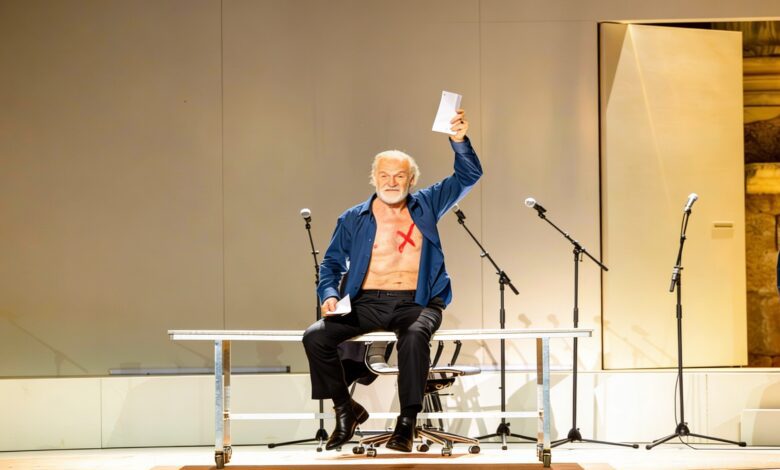
The premiere of the play ‘Memoirs of Hadrian’ at Romea Theatre became a notable cultural event for Barcelona and all of Spain. The production not only brought Marguerite Yourcenar’s classic novel to life, but also encouraged audiences to reflect on personal loss, power, and human vulnerability. At a time when Spanish society is searching for new meaning in art, this play proved especially relevant.
Luis Omar played the lead role, masterfully conveying the complex emotions of Emperor Hadrian. His performance in the scene recalling Antinous’ death plunged the auditorium into complete silence—the audience held its breath, feeling the hero’s tragedy. As noted by El Pais, this moment became the emotional core of the evening, with applause after the finale lasting longer than usual.
A modern take on the classics
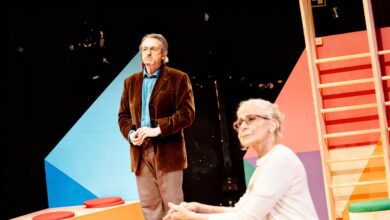
The production, created in collaboration with Focus, was first presented this summer at the festival in Mérida and has now arrived in Barcelona. Director Beatriz Jaén and playwright Brenda Escobedo offered an unusual interpretation: Hadrian is portrayed not only as a historical figure, but also as a modern leader recording an address to the nation. Surrounded by a team of advisors, cameramen, and stylists, the action gains contemporary relevance, reminding us of modern mechanisms of power.
Luis Omar, who is nearly 69 years old, appeared on stage in excellent physical shape. His monologues, based on Julio Cortázar’s translation, sounded fresh and convincing. The actor shared reflections on aging, love for art, military campaigns, and personal fears. An important part of the performance was a scene where Adrian talks about his childhood in Spain, his studies in Athens, and his military service. These details allowed the audience to see the emperor not just as a ruler, but as a person with his own vulnerabilities.
Emotions and visual solutions
The scenography deserves special mention: images of Adrian’s profile appeared on the screens, resembling busts in a museum, while the scene with memories of the young Antinous was accompanied by dance and Eastern melodies. At that moment, the Romea hall fell silent, and the actors’ emotions resonated with every spectator. According to El Pais, this particular scene became the highlight of the evening, and the image of Antinous, embodied by dancer Álvaro Nahuel, added depth to the production.
Other cast members interacted around the main character: Javi Casan, Beatriz Jaén, Ricard Boil, and Clara Minguesa. Each played several roles—from advisers to technical experts—emphasizing the idea of power as a collective process. This approach enabled the audience to view history through a contemporary lens and consider how perceptions of leaders evolve over time.
Historical context and cultural parallels
After the performance, Luis Omar noted that adapting Yourcenar’s text was a difficult but necessary task for the stage version. He emphasized that the new production focuses on political marketing and current issues of power. According to him, the play would be especially useful for politicians as a reminder of the values that mattered to Hadrian and remain relevant today.
The production of “Memoirs of Hadrian” will continue touring Spain until May, and public interest remains strong. In recent years, there has been growing interest in theatrical experiments and new interpretations of classics in the country. For example, after a film was shot in Monells, Catalonia, tourist traffic to the region noticeably increased, which is described in detail in a report on the impact of film projects on life in small towns — how filmmaking changes the atmosphere and economy of regions.
Background and latest developments
In recent years, Spanish theaters have increasingly reinterpreted classic works, employing modern technologies and innovative directorial approaches. Productions where historical characters are given new traits are gaining popularity not only in Barcelona, but also in other cities across the country. In 2025, a festival in Madrid showcased adaptations of ancient tragedies featuring elements of digital art. Such projects attract a broad audience and foster cultural dialogue between generations. The Romea Theater continues to be one of the leading venues for premieres, blending tradition with contemporary trends.