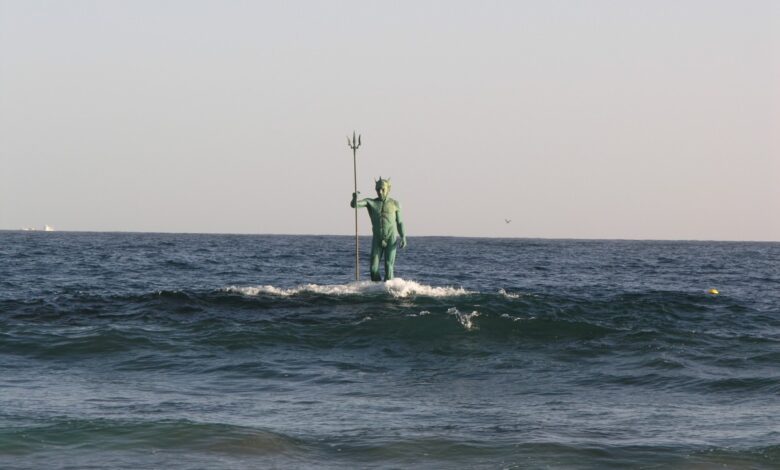
Melenara Beach on the eastern coast of Gran Canaria has long been a magnet not only for holidaymakers but also for those seeking something more than just sea and sun. Here, amid the dark volcanic sand and restless waves, rises a bronze figure that at times disappears into the depths and then reappears before your eyes. It’s more than just an ornament—it’s a symbol that transforms the beach’s character and the mood of everyone nearby.
The sculpture of Neptune, installed right in the water, has become a real challenge for photographers and lovers of spectacular views. Depending on the time of day and the tide, it either appears to emerge from the depths of the ocean or stand on a rock as if guarding the coast. This effect is created thanks to its unique location and constant interaction with the sea. Every time the water recedes, a new angle opens up, and when the surf is high, the figure seems to battle the waves crashing against it.
A source of energy
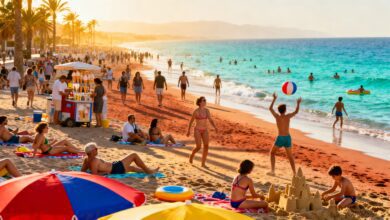
Melenara Beach is more than just a spot on the map. It’s one of the most renowned coastal areas in the municipality of Telde, combining tranquility, natural beauty, and well-developed infrastructure. Volcanic sands, a shell-shaped bay, cleanliness, and careful maintenance—all this draws both locals and visitors to the island. The Blue Flag awarded to Melenara confirms its high standards of safety and environmental care.
A stroll along the promenade offers not only stunning ocean views but also plenty of places to relax: picnic areas, playgrounds, and parks. The Neptune sculpture has become an integral part of this landscape, connecting the beach to nearby neighborhoods like Taliarte and Salinetas. Life is always bustling here, but it’s the figure in the sea that sets a special pace for the entire coast.
The story behind its creation
At first glance, the bronze giant might seem like a natural part of the landscape, but in reality, it’s the result of the meticulous work of sculptor Luis Arencibia Betancor. Unveiled in 2001, the statue depicts the Roman god of the sea — Neptune, known as Poseidon in Greek mythology. The sculpture stands over four meters tall and holds a trident — a recognizable symbol of dominion over the ocean.
The choice of this particular figure is no coincidence. For Gran Canaria’s residents, the sea has always been an essential part of life, a source of sustenance, inspiration, and even danger. Neptune serves as a reminder of the island’s close bond with the ocean, and how nature and people can coexist despite all challenges.
Tested by the elements
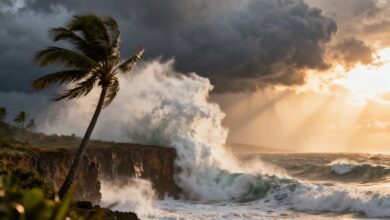
The sculpture is more than just a decoration on the coast — it faces the might of the Atlantic every day. The most striking moments come when waves crash thunderously against the bronze figure and sprays soar several meters high. In those seconds, it truly seems like Neptune is battling the sea, never giving an inch.
Over the years, the statue has faced many challenges. The most notable incident occurred during a storm, when the arm holding the trident was damaged. This required urgent intervention from specialists to reinforce the structure and preserve its original appearance. Despite all the difficulties, the figure still stands in its place, inspiring admiration and respect.
The Magic of Change
At different times of the day and in various weather conditions, the sculpture appears completely transformed. At dawn, it seems to dissolve in the mist, while in the evening, as the sun sets beyond the horizon, the bronze takes on golden hues. On stormy days, the figure becomes the center of attention—spectators gather around to witness the dialogue between art and nature.
It’s no surprise that the Neptune of Melenara has become one of the most photographed landmarks along the entire coast. Each picture is unique, as no wave or ray of light is ever the same. For many island visitors, this is more than just a monument—it’s a real event worth experiencing at least once in a lifetime.
Luis Arencibia Betancor, the sculptor, was born in Gran Canaria and has devoted his career to creating works that reflect the spirit and history of the Canary Islands. His pieces can be found in various parts of the archipelago, but it is the Neptune in Melenara that has become the most recognizable symbol of humanity’s connection to the sea. The sculptor is known for his attention to detail and his ability to convey character through form and material. Thanks to his talent, an ordinary beach has turned into a place where art and nature merge into a single whole, and each visit becomes a new discovery.